




Bryce Canyon
October 11, 2010
WOW!
How does one start describing Bryce Canyon? Ebenezer Bryce, who gave the canyon its name and homesteaded here as late as 1874, said: “It’s a hell of a place to lose a cow!”
Last night Hélène had gone to bed while I finished yesterday’s blog entry and had asked me to set the alarm to 8am. I am terrible at multitasking and when I had finished I remembered vaguely that Hélène had said she had set the alarm to 8am.
We were woken up by Iseline who climbed into our bed at 8:30. We only had one thing to do today so we took our time and were at the park at 11am. It seems that 11am has become our standard starting time.
We let the kids vote if they wanted to do a 4.6 km (2.9 miles) hike or an 8.8 km (5.5 miles) hike. The first one won unanimously and we headed towards sunrise point.
On our way I read up on Bryce Canyon geology and explained how it all came to be to the kids.
200 million years ago a mountain range was formed when the Pacific plate collided with the North American plate. 65 million years ago it was mostly flattened and a large area of what is now the US was landlocked with an enormous lake forming on the plain that used to be mountains. This large lake had no outlet and became gradually more and more salty. Lime deposits from the rivers floating into it mixed with remains of organisms that lived in the lake to form sediments on the lake bottom. In the end it was so salty that only cyanobacteria (blue-green algae) could live there. At some point the lake disappeared, either through evaporation or by being emptied into the ocean by a gelogical event. It left behind layer upon layer of sediments from its bottom.
Then, about 16 million years ago, the land was lifted up by plate movements. The sediments from the lake were lifted from around sea level to over 2400 meters (8000 feet) altitude. Erosion did its work over the years creating valleys and canyons. The area that was to become Bryce Canyon was not eroded by running water, but by freezing water. Its location on a high altitude plain far away from an ocean climate gives it extreme temperature differences. There can be as much as 27 degrees celcius (80 F) difference between night and day. For 200 days of the year there is a freeze/thaw cycle between night and day. Water melts during the day working its way though cracks and pores only to freeze and expand again during the night.
Some of the sediments left after the lake are harder than others. When a hard layer is on top of a softer layer monoliths (called “hoodoos”) are created as the ice works its way down and leaves parts of the top layer intact. Thousands of these hoodoos are what make up Bryce Canyon.
Bryce Canyon is never the same from one year to the next. In the spring time it is possible to hear that it is still forming from all the pebbles that fall down the sides of hoodoos.
Oops, sorry, got a bit carried away there.
Given the geology of the area you always start hiking from the plain at about 2400 meters altitude and work your way down to the canyon and then back up again. Our hike through the Queens Garden and Navajo Loop parts of the park turned out to be a very good choice. We walked through an out-of-this-world maze of hoodoos and other bizarre formations.
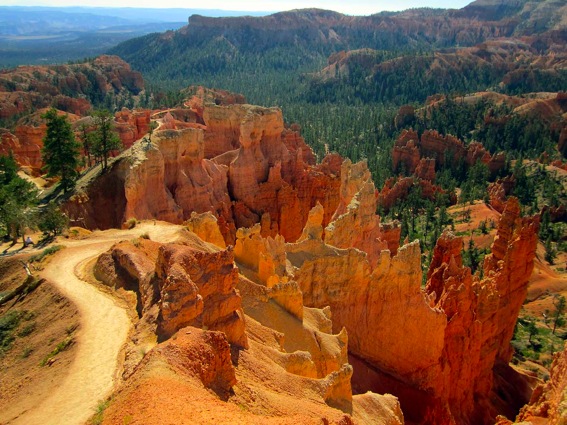
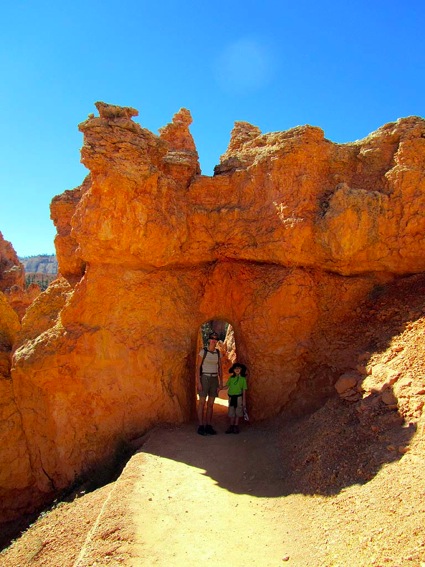
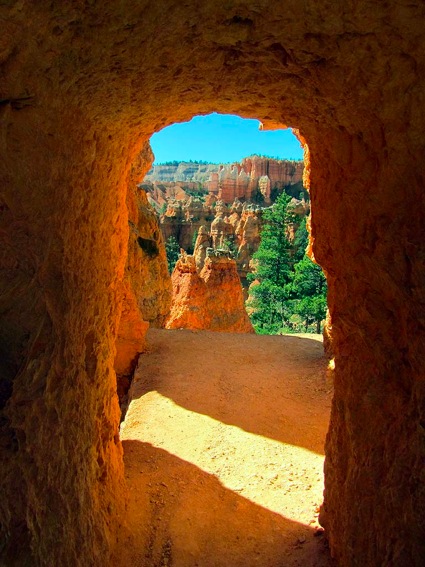
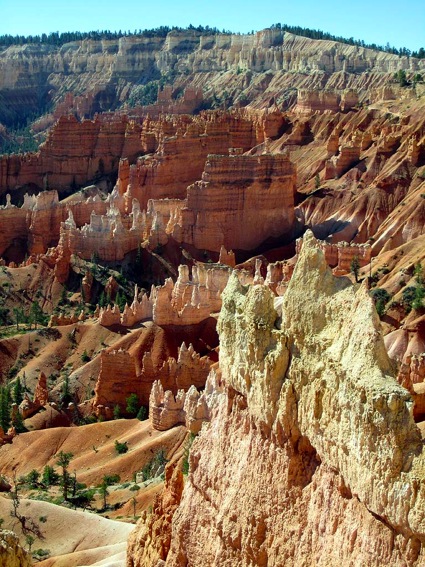
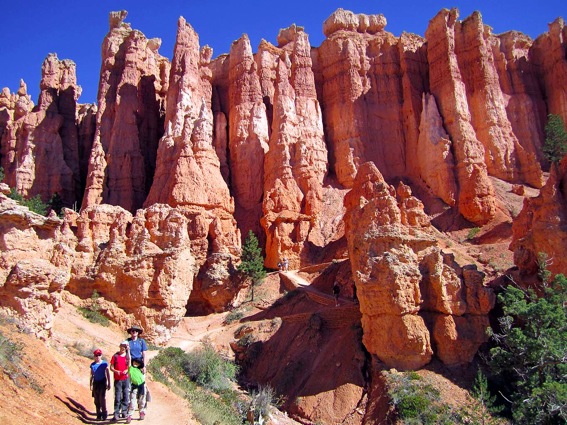
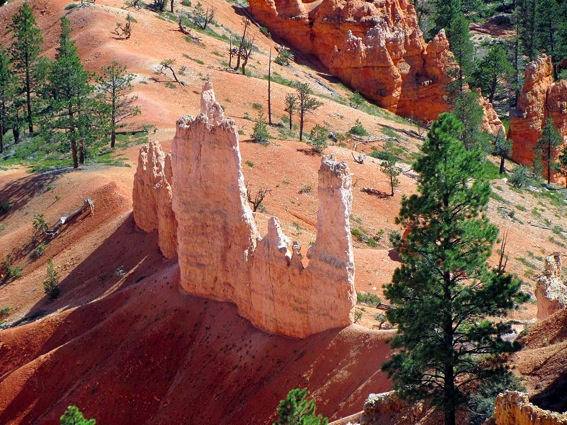
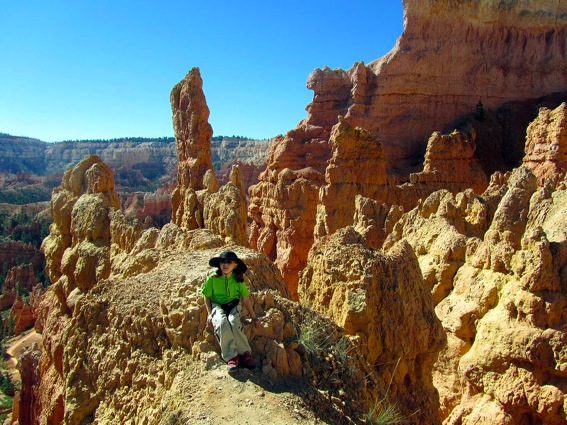
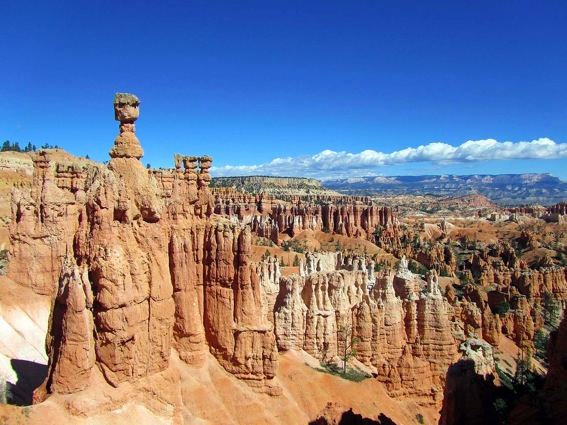
It made us feel small and also privileged to be able to visit such a place. We could sense it in the children also. This was something very special, and they knew it. Even a hard-nosed atheist like myself turned religious for a few seconds.
Many thanks to our friend Paul. He returned from Bryce Canyon years ago and spoke very warmly of it. That’s why we chose it as a destination. He had given me the advice to not stop taking pictures, We took him seriously. I ended up at 277 photos for the day (many of those are panoramas to be stitched together) and Hélene at 105!
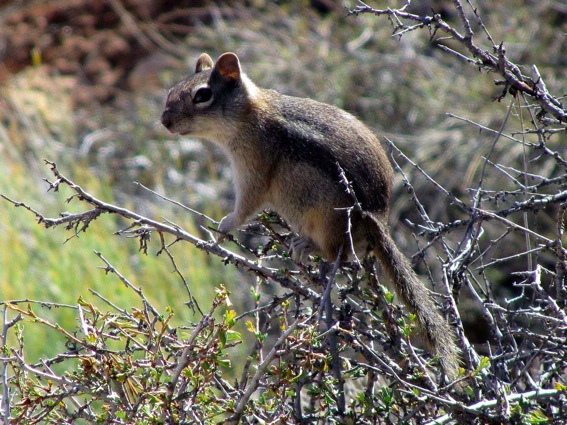
The trail was not only followed by humans. There were chipmunks all over the place. It took me about 20 photos until I shot this one.
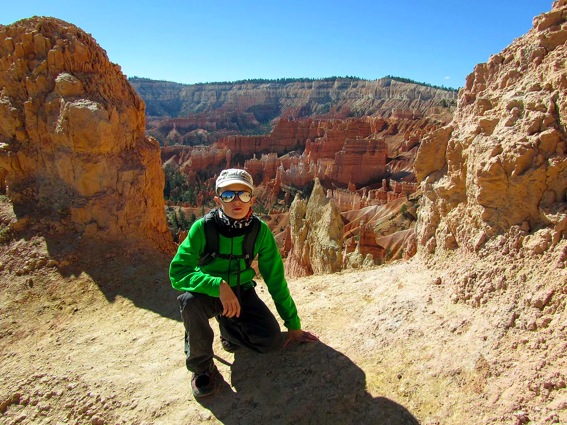
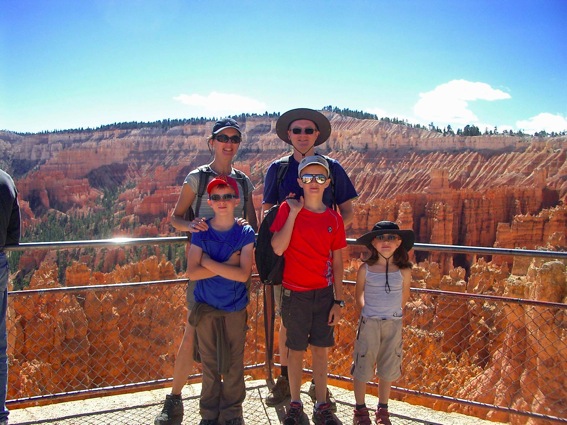
At the last lookout point of the hike someone started speaking Norwegian to us. It turned out to be Roald Wold who was on motorcycle vacation with a US friend. It was good to have someone else to speak Norwegian to and the whole family jumped in on the chat. Roald (on the right here) seemed to be a very nice guy and promised to take a look at our blog.
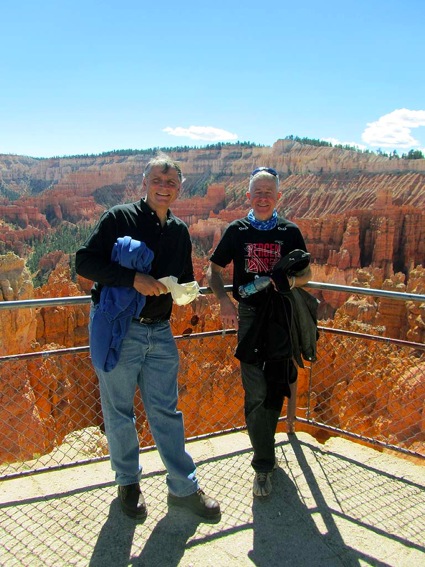
UPDATE: Roald has found the blog and just now emailed me the photo he took of us at the same place. The internet is a cool thing! Here is the photo:
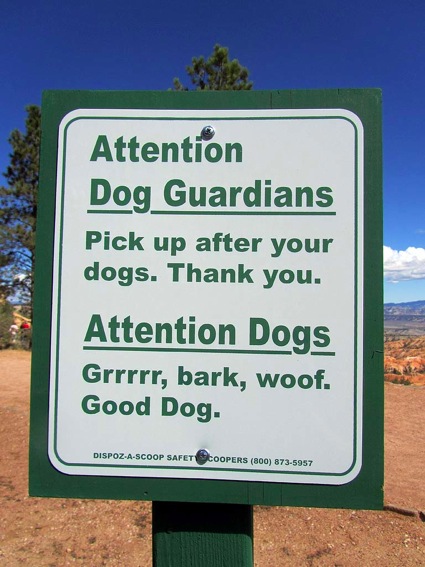
At one of the lookout points we found this cool sign.
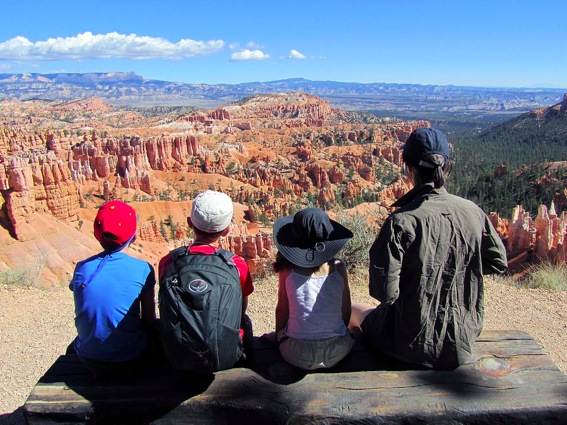
After the hike we found a nice spot with a view and had lunch.
We then drove all the way to the other end of the national park, about 25km (15 miles) and stopped at many lookout points. It just went on and on. What a fantastic place. It’s also quite striking how the forest covered plain looks so normal and dull, only to suddenly be broken by cliffs and spectacular views. What mustn’t it have been like for the first hunting humans who stumbled onto this wonder by chance?
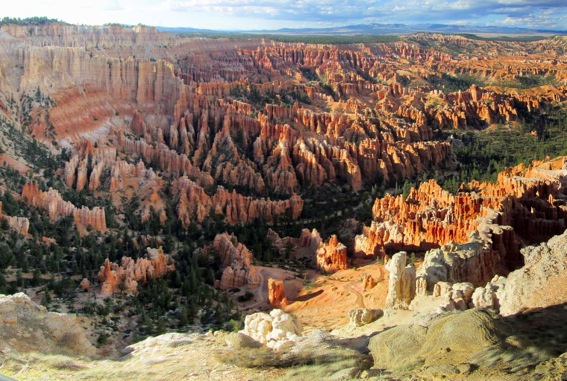
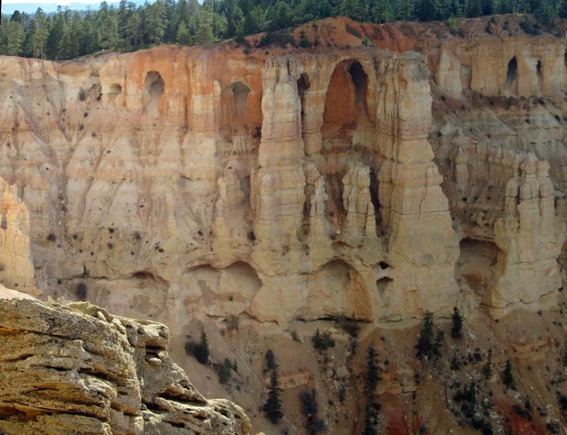
That, by the way, is my prize photo of the day. Bryce Amphitheater photographed from Bryce Point. Stitched together from 5 individual photos. It has been soooo difficult to select a few photos from the many good ones for this blog entry. I have to sneak in one more. This is part of the rim of the canyon seen from Bryce Point:
At one of the last lookout points Iseline was starting to have enough. When we got back into the car she said: “I want to go back to the hotel. Are we finished looking at the park with all the rocks now?” Everyone else laughed.
That reminds me of another good Iseline quote. When we entered the caves at Pinnacles National Monument she went in first and yelled “Mom, you are never going to get your bottom through here!”
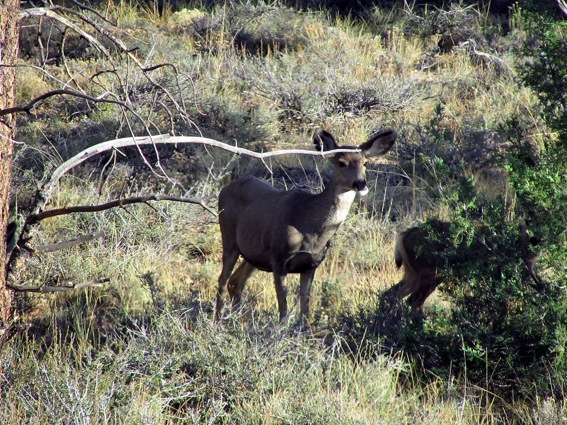
On our way out of the park we spotted some deer. 14x optical zoom comes in handy from time to time.
We returned completely exhausted to the hotel at 6pm. The kids had been talking about the pool of the hotel all day and we gave in. Half an hour in the pool was actually a good way to relax.

Restaurant choice was easy. There are two here and one had a large sign on the outside saying “Dinner Cowboy Show.” We chose the other one. Tomorrow morning we will drive down to another natural wonder: The Grand Canyon.
Eirik
—–

Awesome photos, thanks for that! In Oslo the temp dips just below zero at night now, your pics look much more inviting for that reason alone.
Have fun 🙂
Takk for fine ord. Flotte bilder. Dere er toeffe. God tur videre og lykke til med undervisningen !!! Take care. Roald
Chipmunks? That’s nothing: I just saw a rat in the kitchen’s restaurant in Yogyakarta.
The pictures look absolutely awesome, esp. the fourth one from the top. And the cool sign is very cool indeed.
To quote Mr. Z: Have fun!
Merveilleux et fantastique Merci pour les explications Cours de géo quotidien
Bravo
quel bonheur apres une journée de boulot de voyager grace a vous et de partager ses paysages magnifiques.
demain soir j’irai verifier si les demoiselles coiffées de Sachas ne sont pas vexées de vos commentaires!!!
bisous
For et fantastisk sted! Utrolig fine bilder, Eirik.
Glad you enjoyed it Eirik. I have fond memories of visiting Bryce Canyon almost 20 years ago, and it was good to see the pictures. Of course we didn’t have those new-fangled digital cameras back then, so I had to limit myself to a roll or two of film…