





National Museum of the American Indian
October 27, 2010
We had gotten a tip from Shelly at CIVIC that we should visit the National Museum of the American Indian. We removed the natural history museum from our to do list and headed downtown this morning.
The building is a work of art in its own right:

The museum was really impressive and gave a great presentation of the history, culture, contemporary life, philosophy and tradegy of the American Indians.
Nine out of ten American Indians died in the first century after European contact. The suffering and loss of cultures is difficult to grasp. It was clear that it had an impact on the boys as we worked our way through the history part of the museum.

There were lots of video screens and many stories were told by modern day American Indians. It was a fascinating place and we spent our whole day there.
The boys enjoyed the museum and were paying attention and sucking in information all the time. For Iseline, however, it went a bit over her head and she quickly got bored. At one point she said: “This is really boring, there are only Indian things in here, I want to go back.”
One highlight for her was videos of American Indian fairy tales. I sat down beside her and translated.
I found one fairy tale particularly interesting. It was about a girl who was lonely and went out into the world and found 7 big brothers. At the end they were attacked by a Bison, climbed up a tree, made it magically grow very high and then escaped by turning into stars and jumping into the sky. These stars are the 8 stars that make up the big dipper.
Very interesting, since the big dipper is made of 7 stars. One of them, however, Mizar (the second on the handle starting from the tip), has a companion called Alcor. These two stars are also called the horse and the rider. My guess is that the little sister is the star Alcor. Alcor can be seen with the naked eye if you have very good eyesight. Being able to see Alcor has been used as an eye test by many different cultures. It has been used as an eye chart in the sky by at least the Romans, the Babylonians, the Arabs, the good old English and also by native Americans. It is said that to be able to join the Roman army the eyesight test was the ability to see Alcor.
The interesting question I am asking myself after hearing that fairy tale is if Alcor shone more brightly a long time ago. Would it be natural to have such a fairy tale about a star that was not visible to everyone? Or was it just that much more visible when there was no background light pollution? If it was indeed easy to see, why would the Romans use it as an eye test? Maybe you didn’t need eagle vision to be a Roman soldier? That would greatly reduce the number of potential soldiers. At a time when glasses were not used it could simply have been a test to see if you had normal vision. It is tempting to believe that Alcor is dimmer now than it used to be, but I have no other sources than a native American fairy tale and my own brain.
Sorry.
It was a stark reminder of what we are doing to this earth to again see the American Indian philosophy and relationship to nature.


It reminded me of a comment from Hopi/Zuni Indians in Jared Diamonds fantastc book Collapse: How Societies Choose to Fail or Succeed: “We were here long before you came, and we expect still to be here long after you too are gone.”
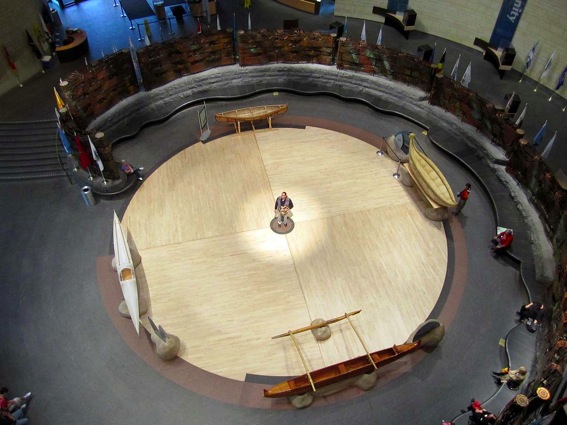
At the entrance there is a great hall that stretches all the way to the top of the building. At one point a guy got out into the middle of the floor and started telling us about American Indian music and rhythm and then played on his drum and sang. The acoustics were mighty and he made the whole museum resonate with hypnotic rhythms.
The cafeteria was fantastic with lots of different dishes from different parts of the US. I had bison beef. Adrian had a hamburger and a cookie:

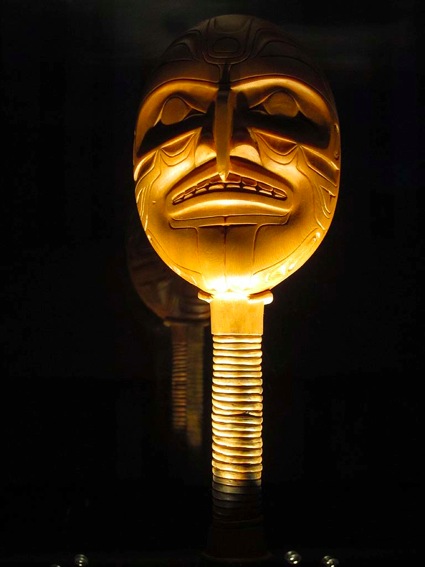
We were so fascinated by the museum that we forgot to take a lot of pictures. Here is one more, though:
In the end Iseline only wanted to be lifted and kept wanting to go home. It is difficult to adjust activities with the age difference between the kids and we need to find something more adapted to Iseline soon.
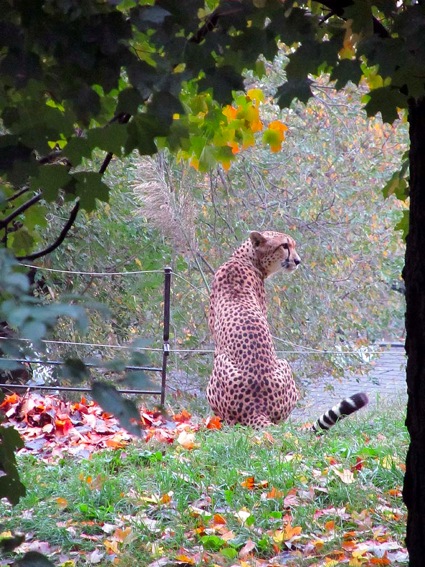
On the way home we took a brief walk in the zoo, which she enjoys. It’s handy to be just next to a great zoo with no entrance fee. We got to see this guy today:
It rained heavily today, but only while we were inside the museum. The temperature was very high, probably around 25 Celsius (close to 80F) and I walked around in shorts. Humidity was surely 100% and reminded me of Chattanooga, where we will be soon. The weather forecast says 12 C (close to 50F) for Friday, but we will be out of here by then.
See you around, folks!
Eirik
—–
