




Easter Island – Day 1 – Ahu and Moai
January 3, 2011
After a great breakfast Christophe was ready to give us a full day tour of the island at 9 am. I had chosen Cabanas Christophe because Christophe had a very god reputation on TripAdvisor and because he gave private guided tours in French at an unbeatable price.
Lats night at dinner I had briefed the rest of family about everything I had read from the book “Island at the End of the World.”
Warning: Long explanation about the history of Polynesians and Easter island written by a history nerd follows. If this does not interest you please scroll down to the photo of the red cylindrical stone.
The history of Easter Island is fascinating, but the history of the Polynesians in general even more so. Just like with the Incas I was blown away by the achievements of this very advanced culture. After the introduction to Polynesian history in the book I turned to Wikpedia and Google to learn more.
It all started about 8000-10000 (!) years ago in southern China where a culture established itself. About 6000 years ago a group of them crossed the Taiwan Strait and settled there. About 5000 years ago they started traveling into the Pacific from Taiwan. They are today known as Austronesians. Within the next 2 millennia they spread through the islands of southeast Asia; The Philipines, Indenoesia, Borneo and beyond.
Roughly 3500 years ago a culture now called the Lapita culture appeared in the Bismarck archipelago north of New Guinea. Within as little as 3 to 4 centuries the Lapita culture had spread 6000 km to the east to populate Fiji, Samoa and Tonga. They probably used large ocean-going double-hull canoes with sails, long before other cultures were able to safely cross oceans (possibly with the exception of the Australian aborigines who crossed the Timor Sea at least 40 000 years ago).
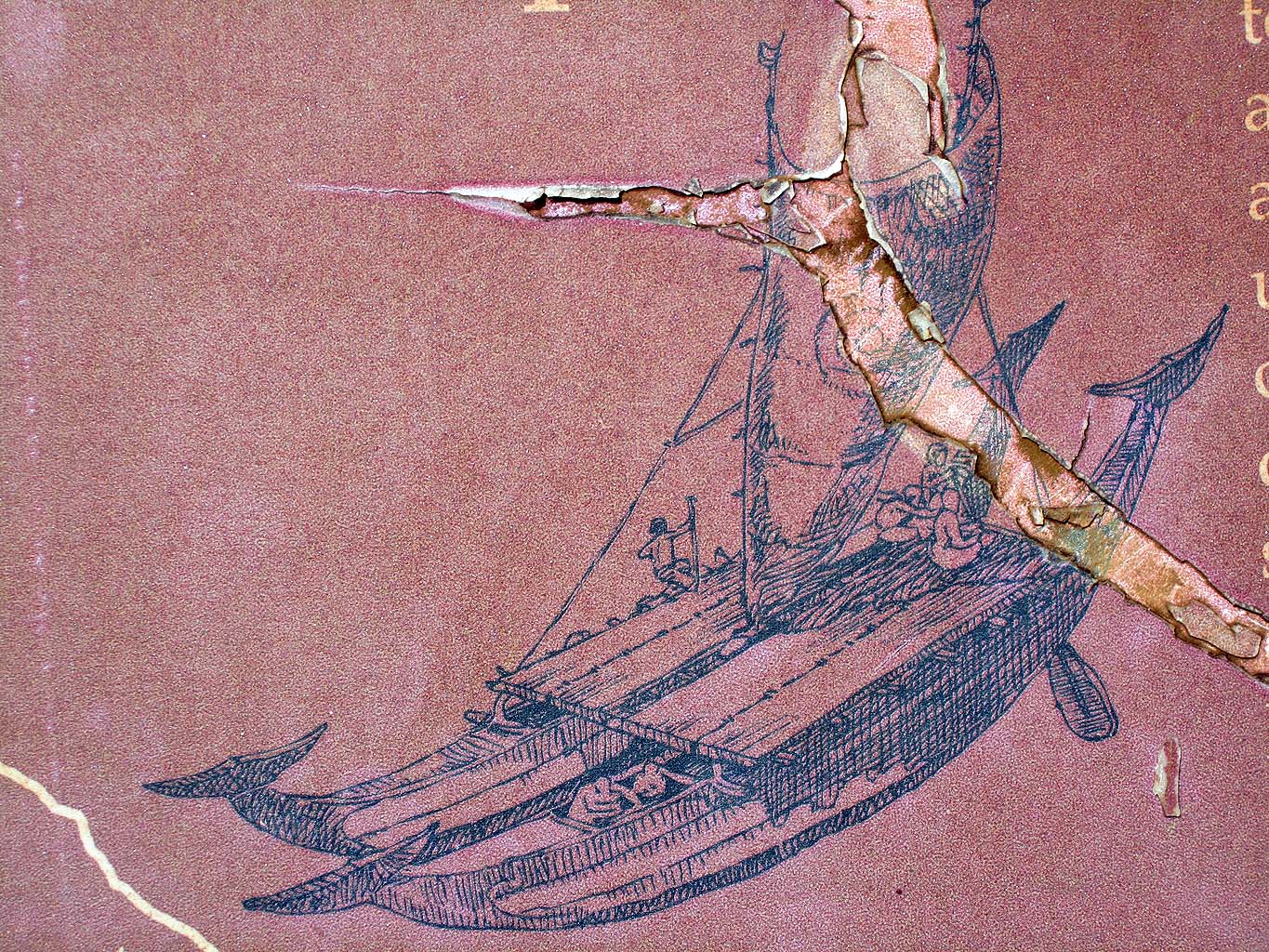
Around 2000 years ago the culture known as the Polynesian culture appeared, probably developed from the Lapita culture. This culture continued the movement eastwards, and also expanded to the north and south. It probably had its base around the Society Islands (which includes Tahiti) in today´s French Polynesia.
From here the Polynesians settled the area known as the Polynesian triangle, the largest area settled by any human culture.The Polynesian triangle is defined by it´s three outermost points: New Zealand, Hawaii and Easter Island. The distance between any two of these points is roughly 8000 km (5000 miles). For comparison Columbus sailed about 5 500 km (3400 miles) when he crossed the Atlantic . Within this vast area the Polynesians established an efficient transport system for cargo and passengers, the so-called Polynesian voyaging sphere, with the “homeland” on or near the Society Islands (possibly Tahiti) as the hub. This network was in operation for almost 500 years, from roughly AD 1000 to AD 1450.
Easter Island was probably settled around AD 600. When the voyaging sphere was in operation the island was not isolated, it was just the furthest outpost on the transportation network. Using double-hull canoes Easter Islanders could travel to Tahiti and then on to places as far away as Hawaii or New Zealand (NZ was populated around AD 1200, probably as the last uninhabited significant landmass on earth), and they did this long before Columbus sailed the ocean blue (in fourteen hundred and ninety two). We know this as a fact from excavations (objects made in one place found in another), genetic analysis (getting fresh genes was vital for small island populations) and language differences and similarities.
The Polynesians were naturally master navigators, several orders of magnitude more advanced than any of their contemporaries. Navigators were held in very high esteem in Polynesian culture. They used many different data sources such as the stars, ocean currents, ocean temperature variations, wind patterns, cloud formations, wave patterns, algae drift patterns and observing birds in flight.
The stars were the most important tool for Polynesian navigators. They had names for over 150 stars. By memorizing many stars´s positions when they rise and set it is possible to use the rising and setting of stars as a very accurate compass. The angle of descent and ascent of stars can be used to determine latitude.
Polynesians were also experts in finding new islands. A scout canoe would be sent out from a settlement against the wind. It would only contain a few people and plenty of supplies, If nothing was found by the time half the supplies were used, they would return, easily making it back in time using the favorable wind. Observing birds in flight, using wave patterns and drifting algae, they could find a new island as soon as they were roughly 200 km (125 miles) from its coastline.
When a new island was found the scouts would plant crops there to help the first settlers. Then they would note the islands position using the stars before they headed back. Canoes with settlers would then be sent to the new land. Each canoe could hold up to 30 people and the supplies they needed to survive the trip and get started. A single canoe could be enough to settle a new island.
In fact, as a side note, an Austronesian culture also settled on Madagascar around AD 100, probably from Borneo. Madagascar is 7000 km (4350 miles) from Borneo. This speaks loudly about their sea-faring capabilities.
In the 1960s something extraordinary was discovered in Micronesia. On some isolated islands there master navigators still existed who used a technique resembling that of the ancient Polynesians. There were very few of them left.
The Polynesian Voyaging Society (PVS) was established in 1973. It works to show that the Polynesians could indeed have maintained their transportation network using the navigation techniques and canoes of the time. They recruited Mau Piailug, the youngest of the remaining Micronesian navigators (in his forties at the time). Mau was chosen by his grandfather to become a navigator when he was 5 years old, when his education started. He had tried to teach his skills to the young in his community, but they were not interested.
The PVS could then with the help of Mau and archaeological knowledge reconstruct the Polynesian navigation system. An ancient navigational system had been documented and saved for humanity in the last moment. Isn´t that fantastic?
In a historic irony the PVS used Thor Heyerdahl´s methods to prove that he was wrong. Heyerdahl did not believe the Polynesians could have navigated large stretches of open ocean. Like most scholars of his time he believed the Polynesians settled the Pacific by accident, by lightweight short-range canoes drifting off course and blown by chance to the next island. He also believed that South Americans first settled on Easter Island and built all the ahus (platforms) and moai (large statues) there. This has now been disproven.
Just like Heyerdahl the PVS constructed an ancient vessel and sailed it to prove it was possible to cross oceans with it.
In 1976 the Hokulea, a replica of a double-hull canoe, left Hawaii and successfully travelled to Tahiti without using any instruments other than the human brain. In 1985-87 the Hokulea sailed from Hawaii and followed 26 000 km (16000 miles) of traditional Polynesian traveling routes, ultimately reaching New Zealand. On this journey it was proven that it was possible to travel bidirectionally using seasonal changes in wind patterns. Finally, in 1999, they closed the Polynesian triangle by successfully traveling from Hawaii to the Marquesas Islands to Mangareva (Gambier Islands) and then on to Easter Island.
If you want to read more about the Polynesian navigation technique there is an article about it on the pages of the PVS.
Why didn´t they teach us about the Polynesians when I was in school? They were the world´s first culture with technology for efficient ocean-crossing and the farthest spanning culture the earth has ever seen.
Unfortunately the Polynesian culture was also one of exploitation of natural resources. They lived as if there were an infinite supply of new islands with new resources. For many centuries it must have seemed like this was the case. They were lucky enough to start on the western brim of the world´s largest ocean, with a very large number of lush islands, most of them in the most favorable climatic zone available to man. Once they reached the extremes, Hawaii, Easter Island and New Zealand there were no new islands with new resources to be found. They did, however, also reach South America, probably from Easter Island (Thor Heyerdahl was on to something, he just got the direction wrong) and returned to Polynesia with South American food crops, at least 1000 years ago.
Polynesians hunted dolphins, birds and land-based mammals to local extinction. They depleted fish and other seafood populations. They would cut down forests and burn them faster then they could be replenished. It could take centuries to destroy the flora and fauna of an island, making it difficult for its inhabitants to understand what was going on until was too late,
In many ways the old Polynesian culture is an example of a culture treating the earth like modern society treats the earth today.
No one knows for sure why the Polynesian voyaging sphere collapsed, it was probably a combination of no new islands to be found and depletion of the existing resources on many Polynesian Islands. Why spend energy on traveling and supplying others, when there are little or no supplies to get from them and you have enough worries with surviving on your own island?
For small isolated islands, like Easter Island, the collapse meant that the inhabitants had to get by with the natural resources on their island and consume them in a sustainable manner. They hadn´t managed to do this when the traveling network was operating and nothing seems to have changed when it collapsed.
When Easter Island was discovered by the Polynesians it was completely covered with thick jungle and had a rich ecosystem. It was home to the highest known palm tree, which could reach 30 meters (100 feet). It was also the home of millions of birds, possibly being the richest bird location on earth, since there were no bird predators there. Its offshore waters were filled with fish and dolphins.
At its height, probably sometime in the 16th century, Easter Island was the home of around 12 000 Polynesians (estimates vary from 7000 to 17000).
By the time the Europeans arrived in the 18th century there was not a single tree over 3 meters (10 feet) left on the island. Dolphins were since long locally extinct (the word for them had been forgotten) and the population was down to about 3000. There was not a single native land animal left that was larger than an insect, everything had been killed and eaten. No mammals (not even bats), no land birds, no snails, no lizards, no amphibians, nothing. The only domesticated animals left were chickens.
Easter Island is a prominent example of how a society can collapse in the highly recommended book Collapse written by Jared Diamond. It gives me shivers to see the parallels to our modern day global society.
Aaaanyway, Cristophe brought us to a number of sites during the day
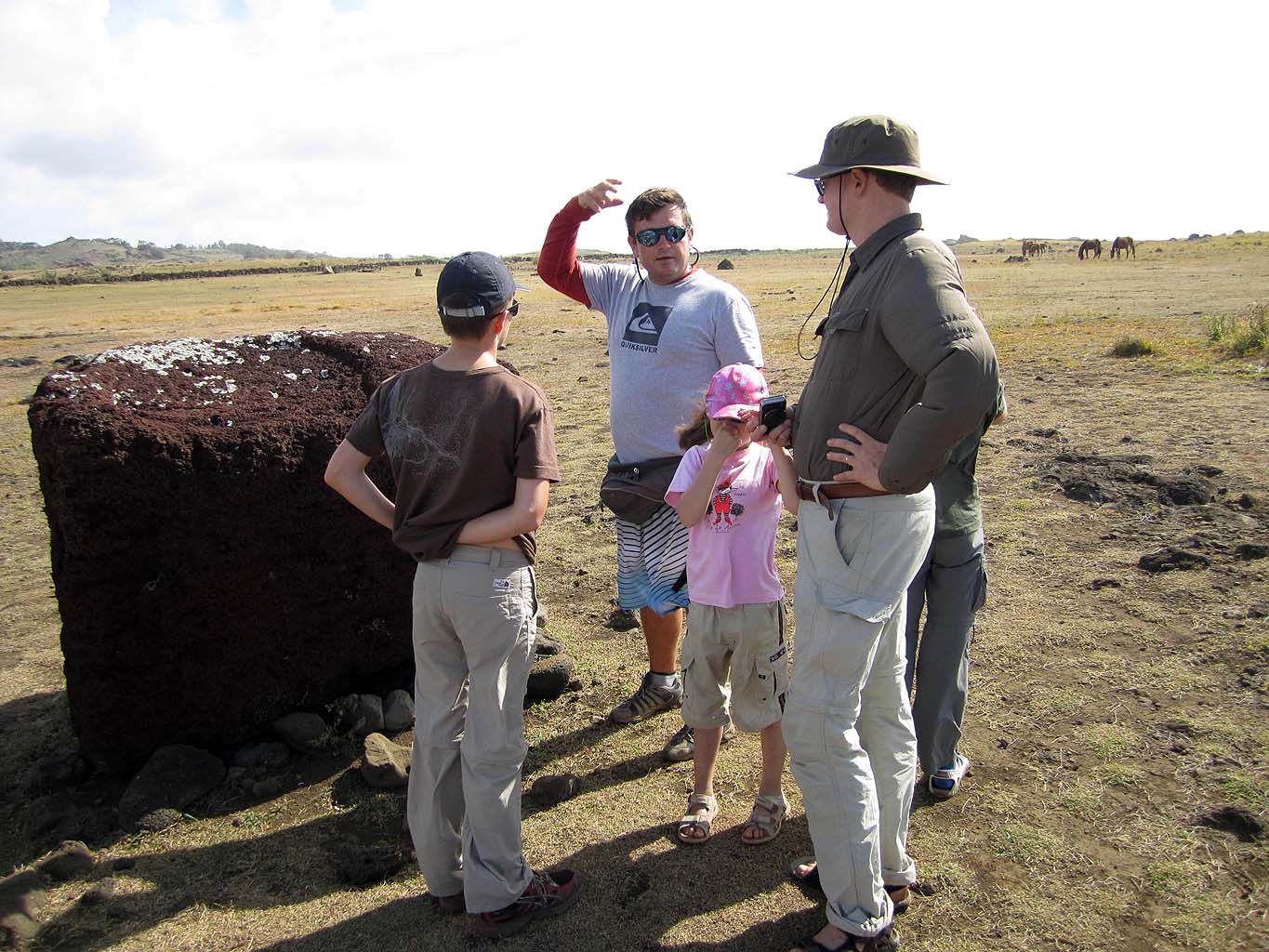
We went to Vaihu and saw some top-knots. Moai production was done from around AD 1250 to AD 1500. Late in that period moai were given red top stones, known as pukao, probably representing hair tied in a knot:
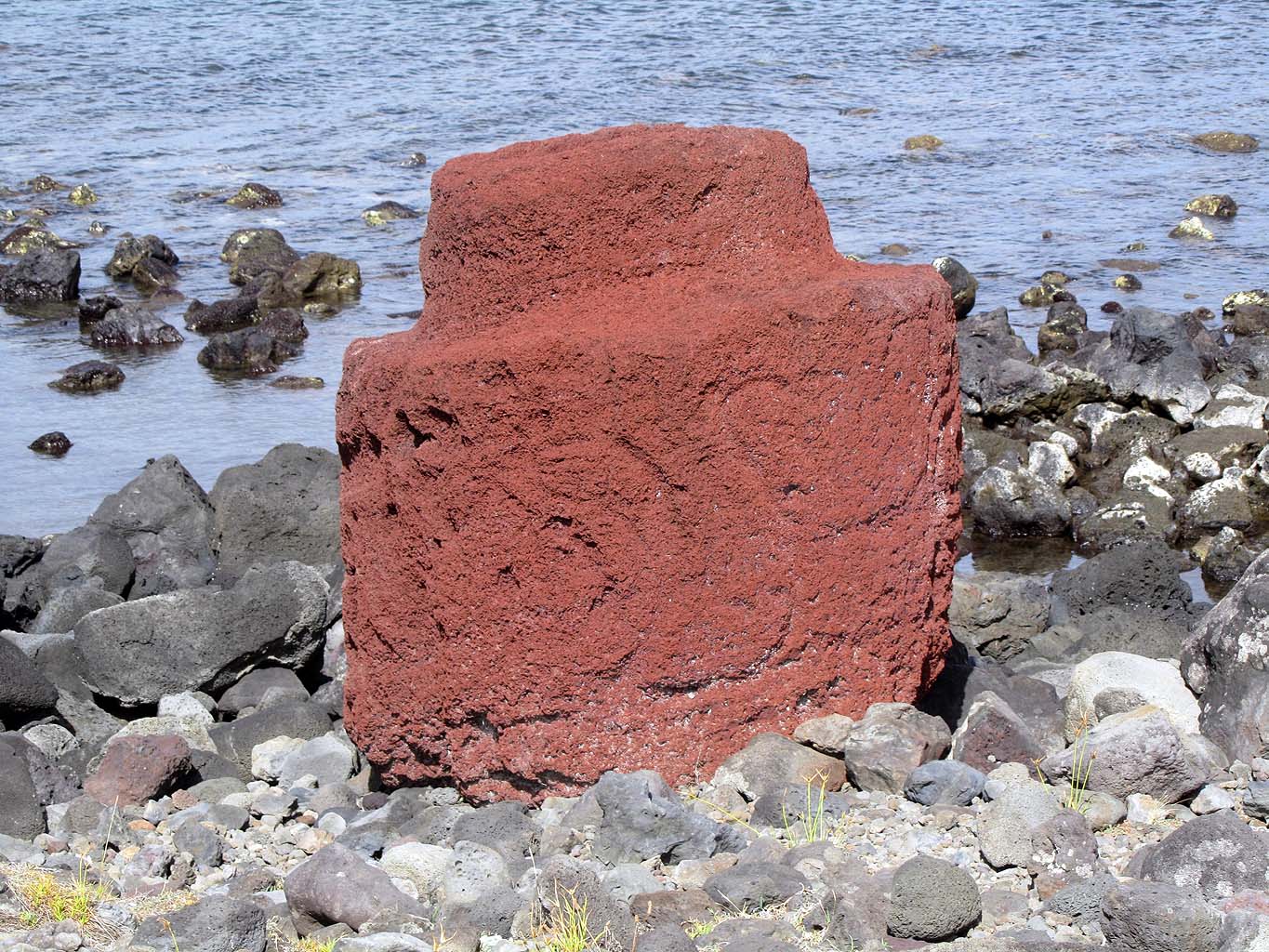
This next one had the bottom facing upwards. you can se it has a cavity. Each pukao was carved to fit on top of the head of the moai it was meant for. Pukaos are made of red scoria, a very light rock.
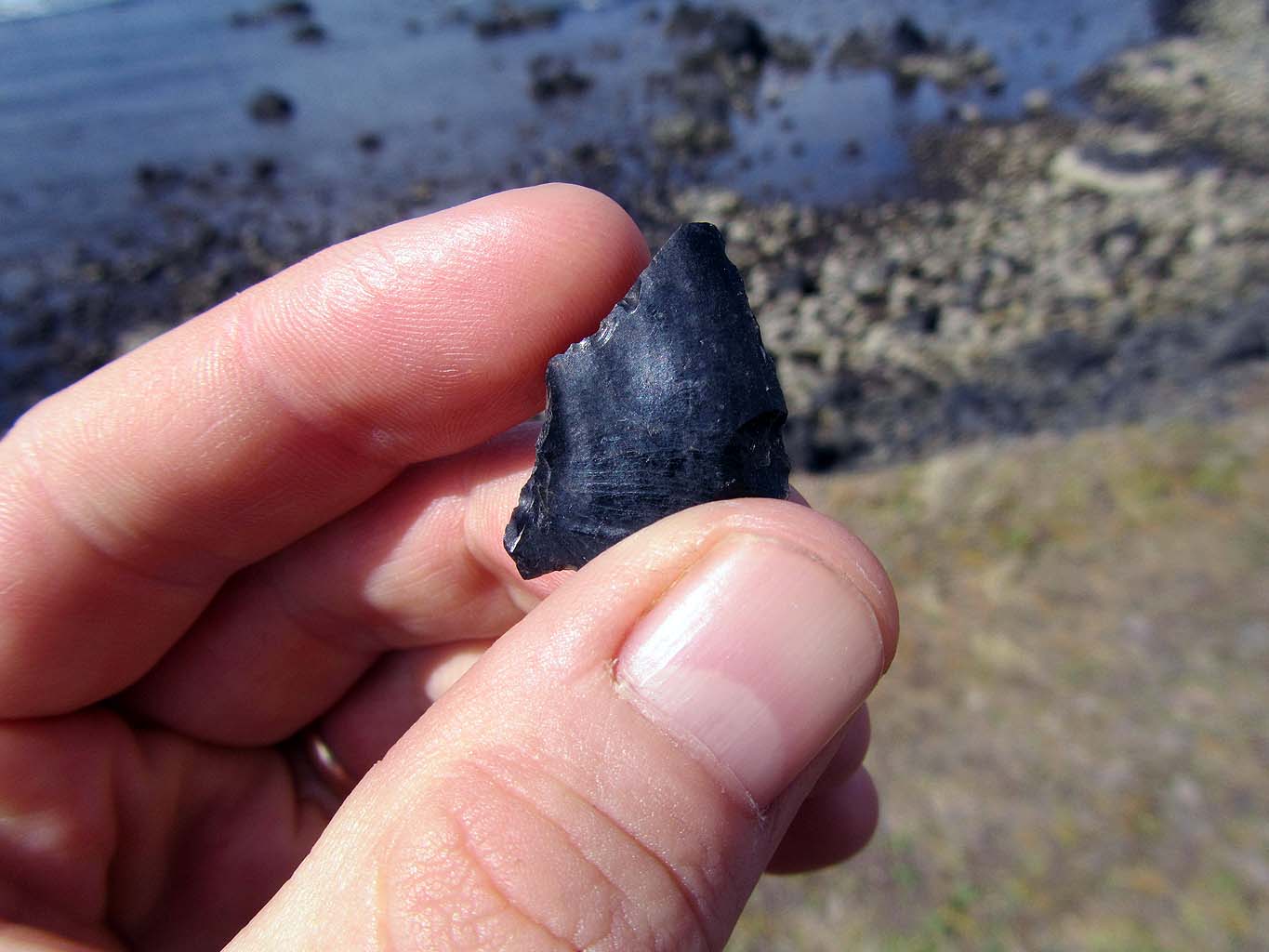
When resources started to be scarce on Easter Island wars between clans erupted, They made weapons from obsidian, a rock that can be made very sharp:
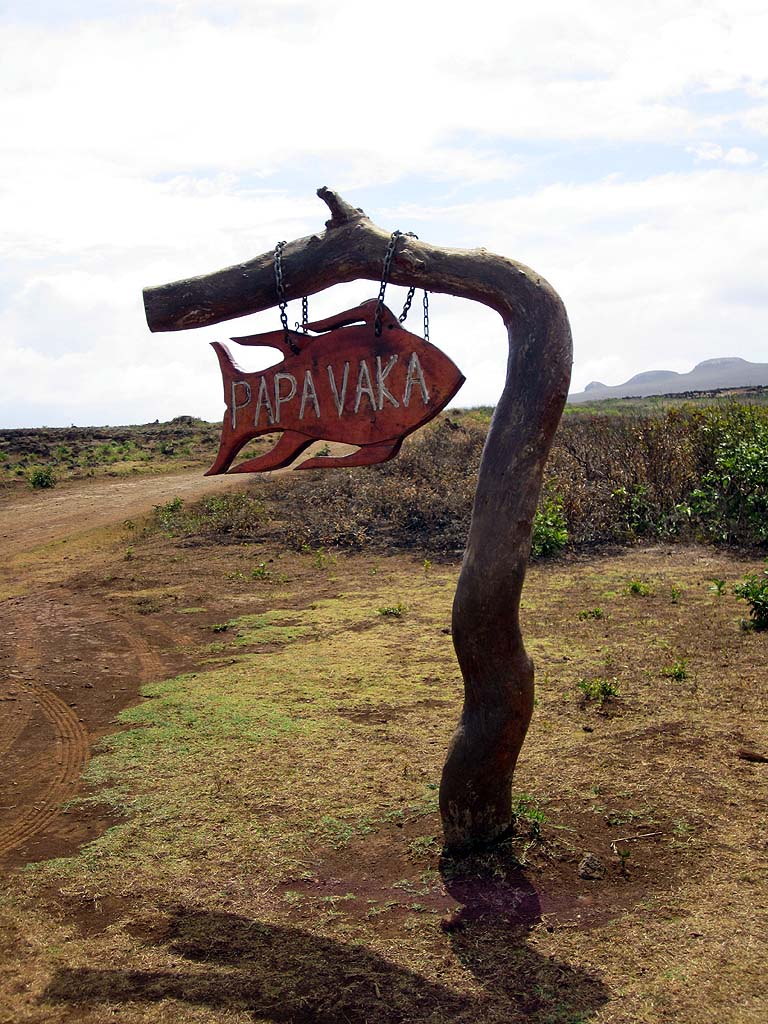
We stopped to see the petroglyphs at Papa Vaka:
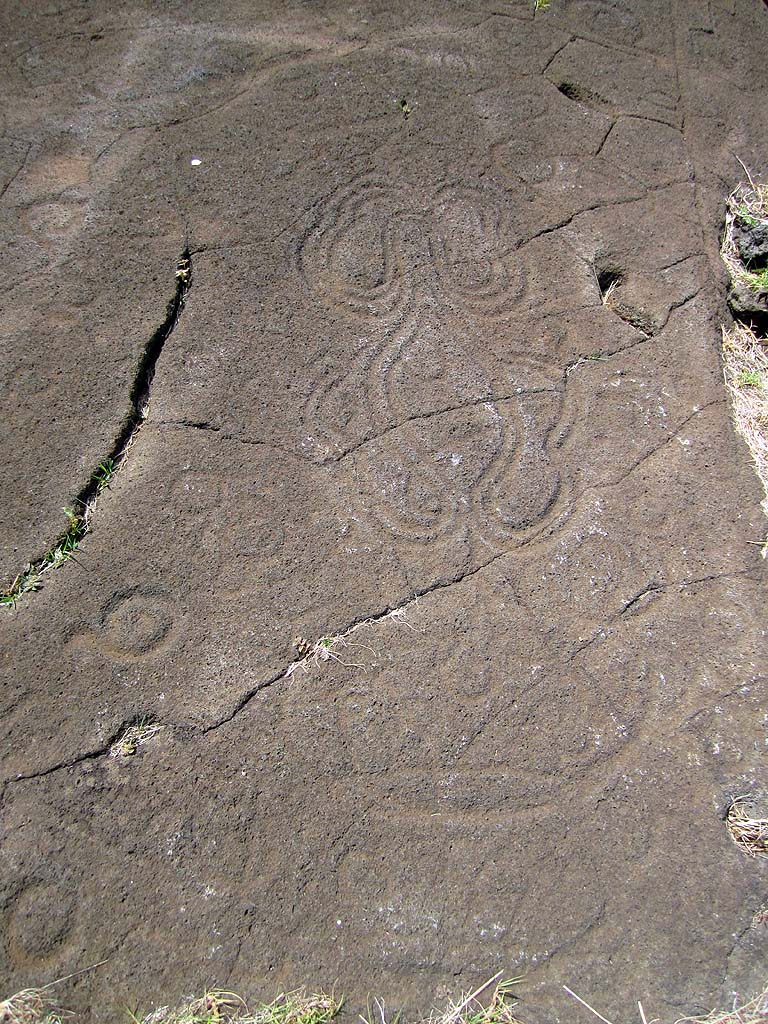
This is probably a squid:
Next we went to Te Pito Kura

where we saw some toppled moai and several chicken houses. There are many of them on the island. If it hadn´t been for the moai Easter Island might have been known as the chicken house island.
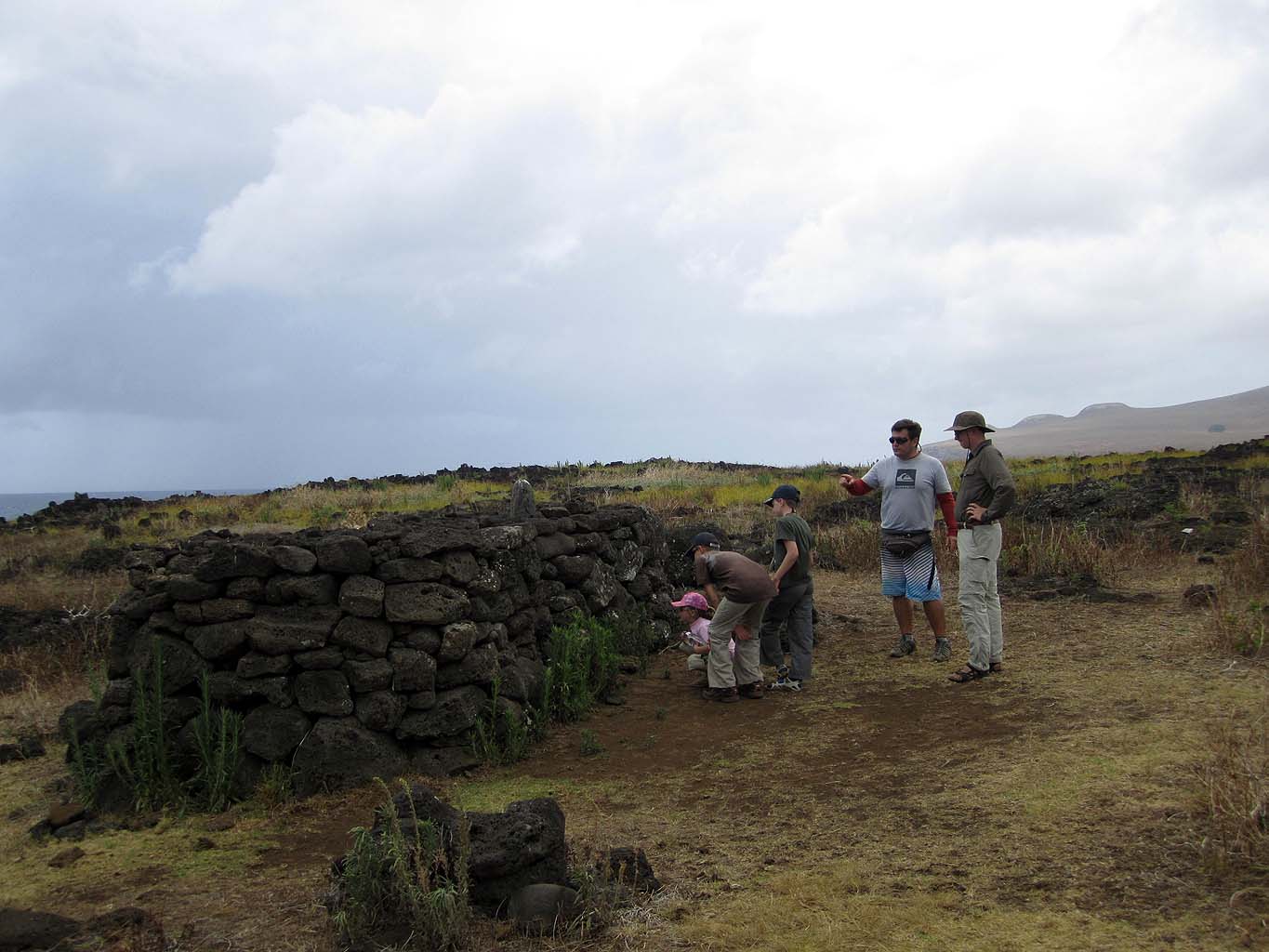
Opening for the chickens:
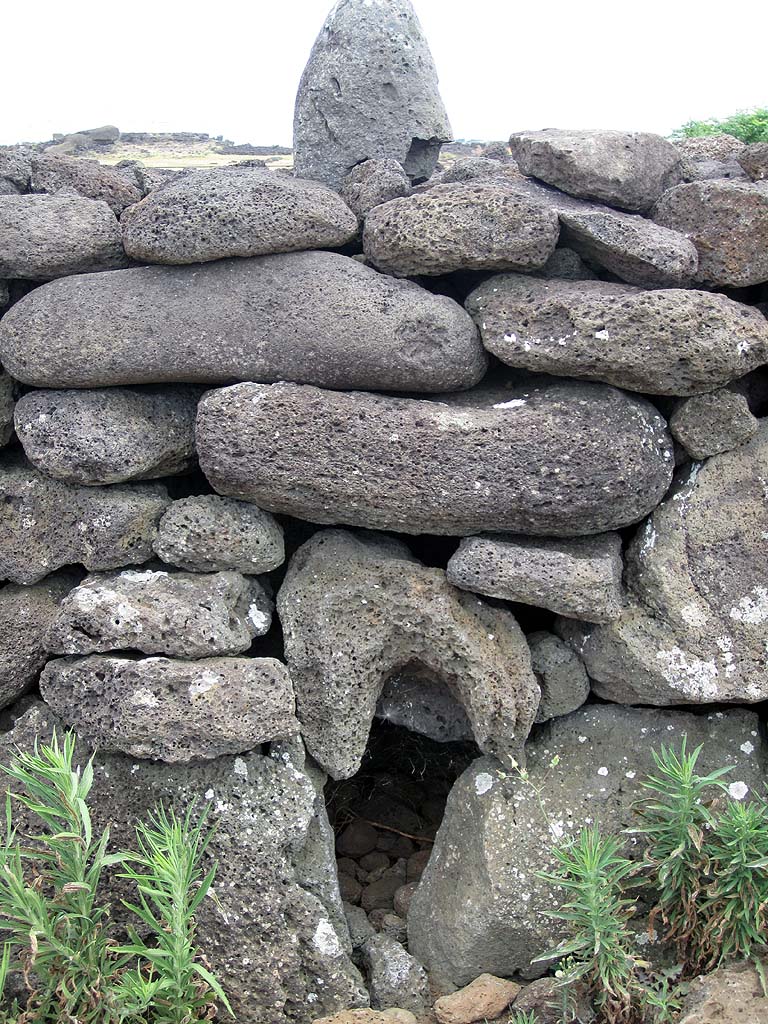
These constructions were not as much to keep the chickens from running away as they were made to make sure no one would steal the chickens during the night (hens never lay eggs in darkness, so they would come out to do that) As Eastern Island gradually lost it´s food production the fight for survival became fiercer.
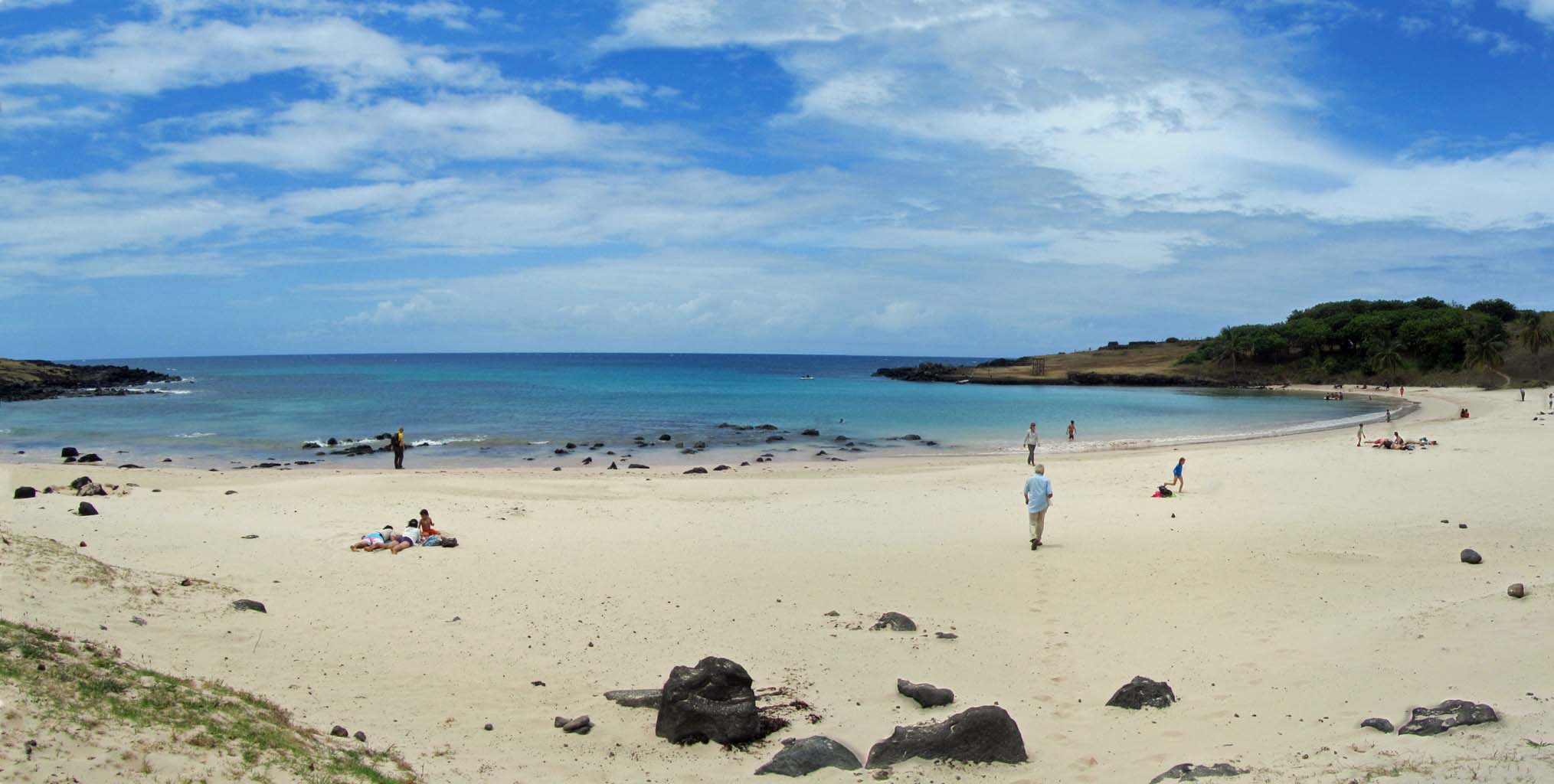
We headed over to Anakena, the last native capital of the island, the home to its only decent beach and a great reconstructed ahu with moai. Now we´re talking:
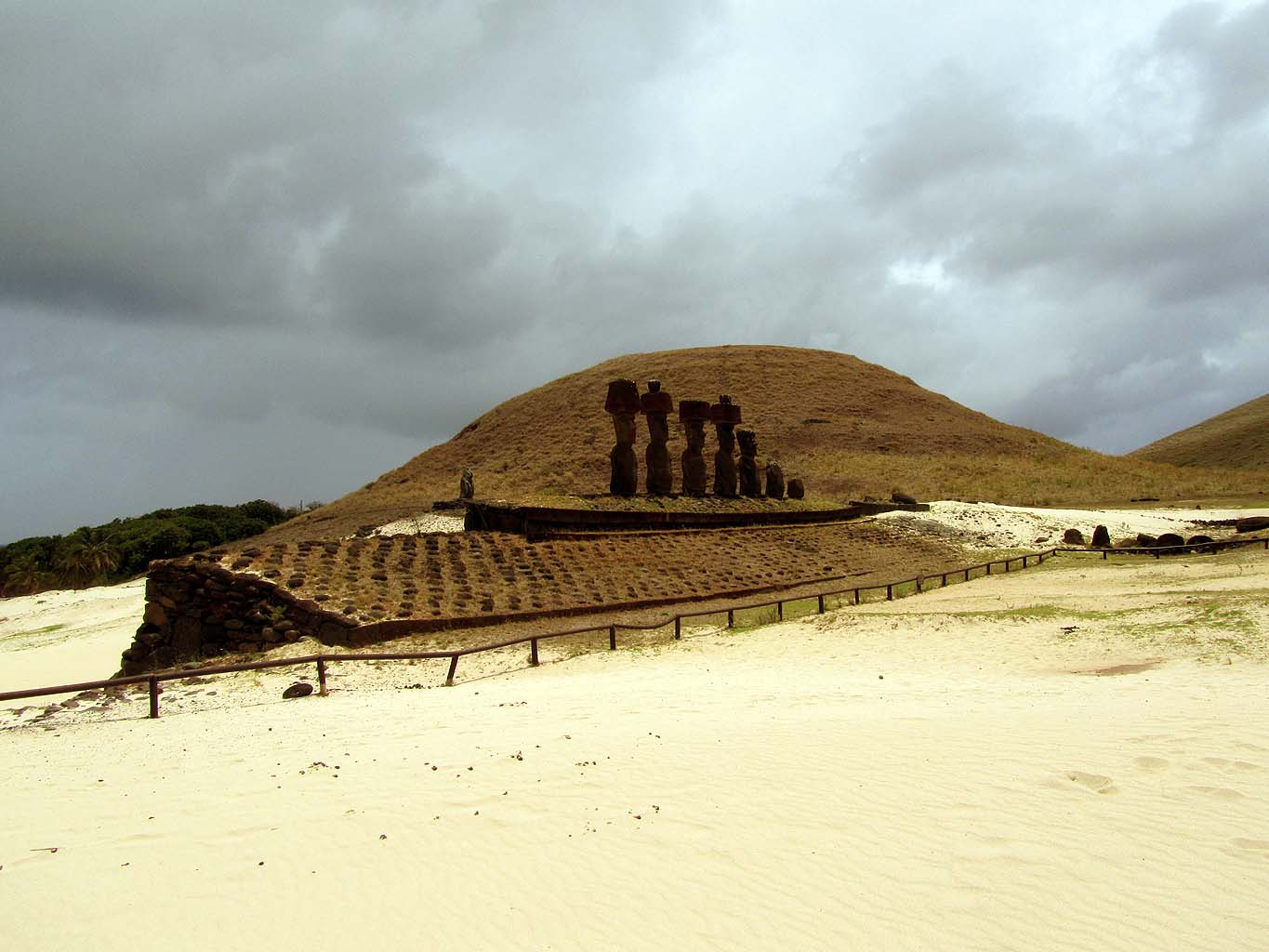
This site was restored in 1980 and contains some of the best preserved moai on the island. This is because they were buried in the sand and thus protected from wind and other erosion.

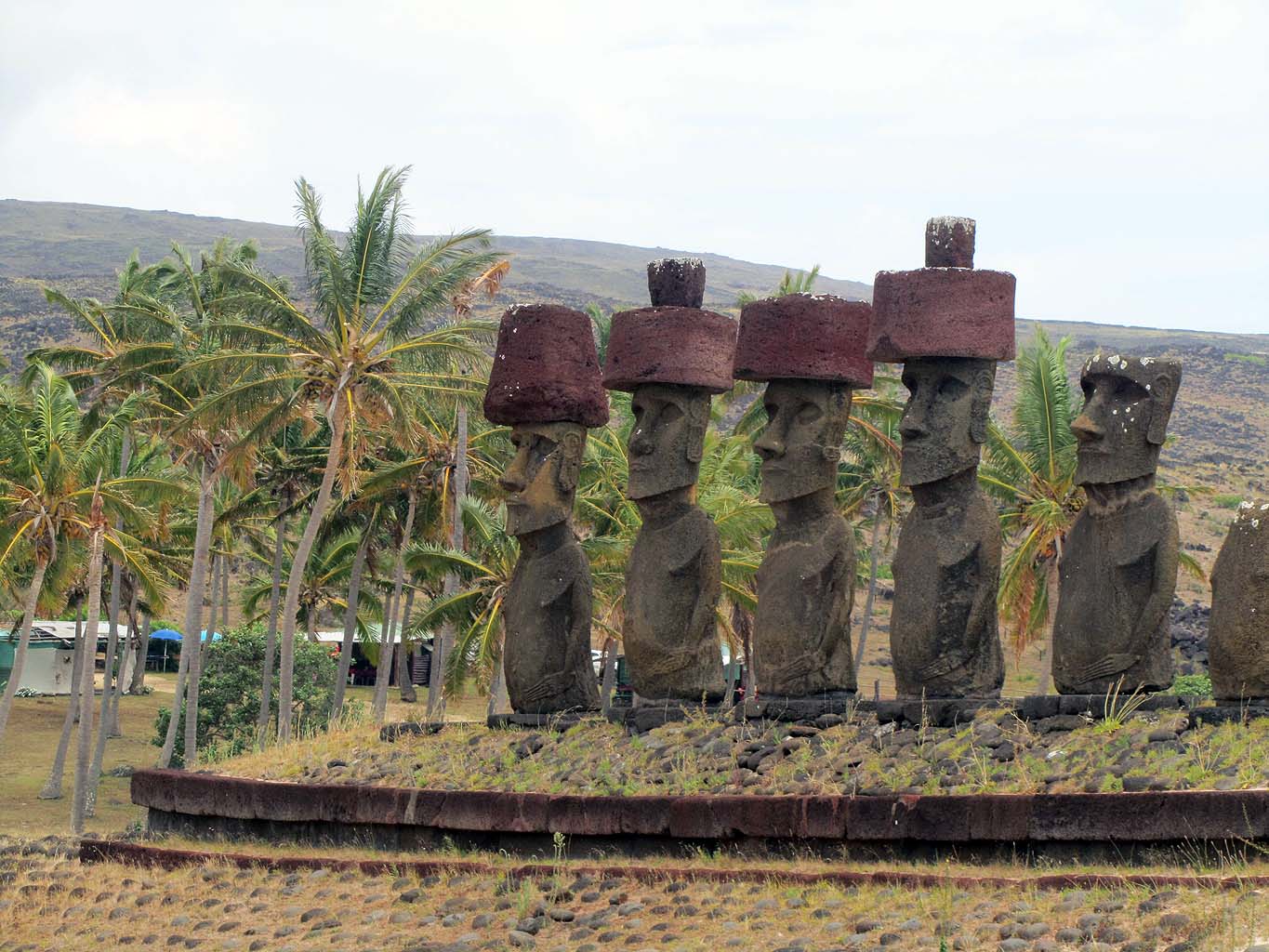
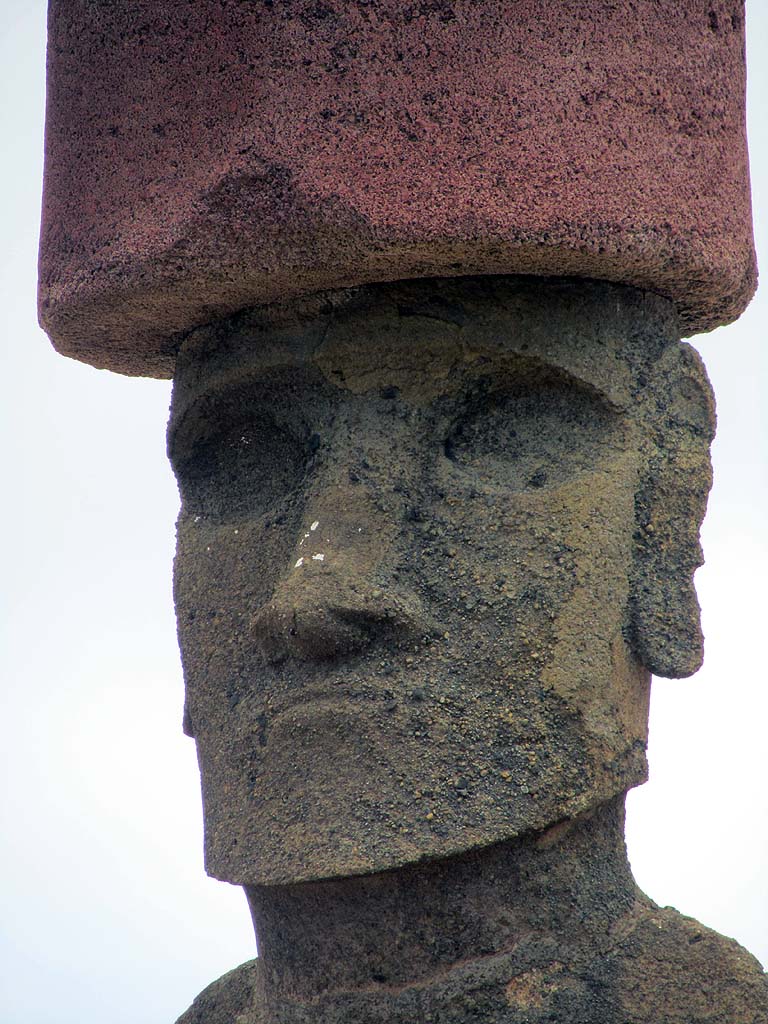
The artwork is impressive. The Easter Islanders brought with them rock carving as a tradition from other Polynesian islands where many so-called tiki can be found. However tiki seem primitive compared to the artistic quality of the moai (which can only be found on Easter Island).
We had lunch at a local place just next to the site:
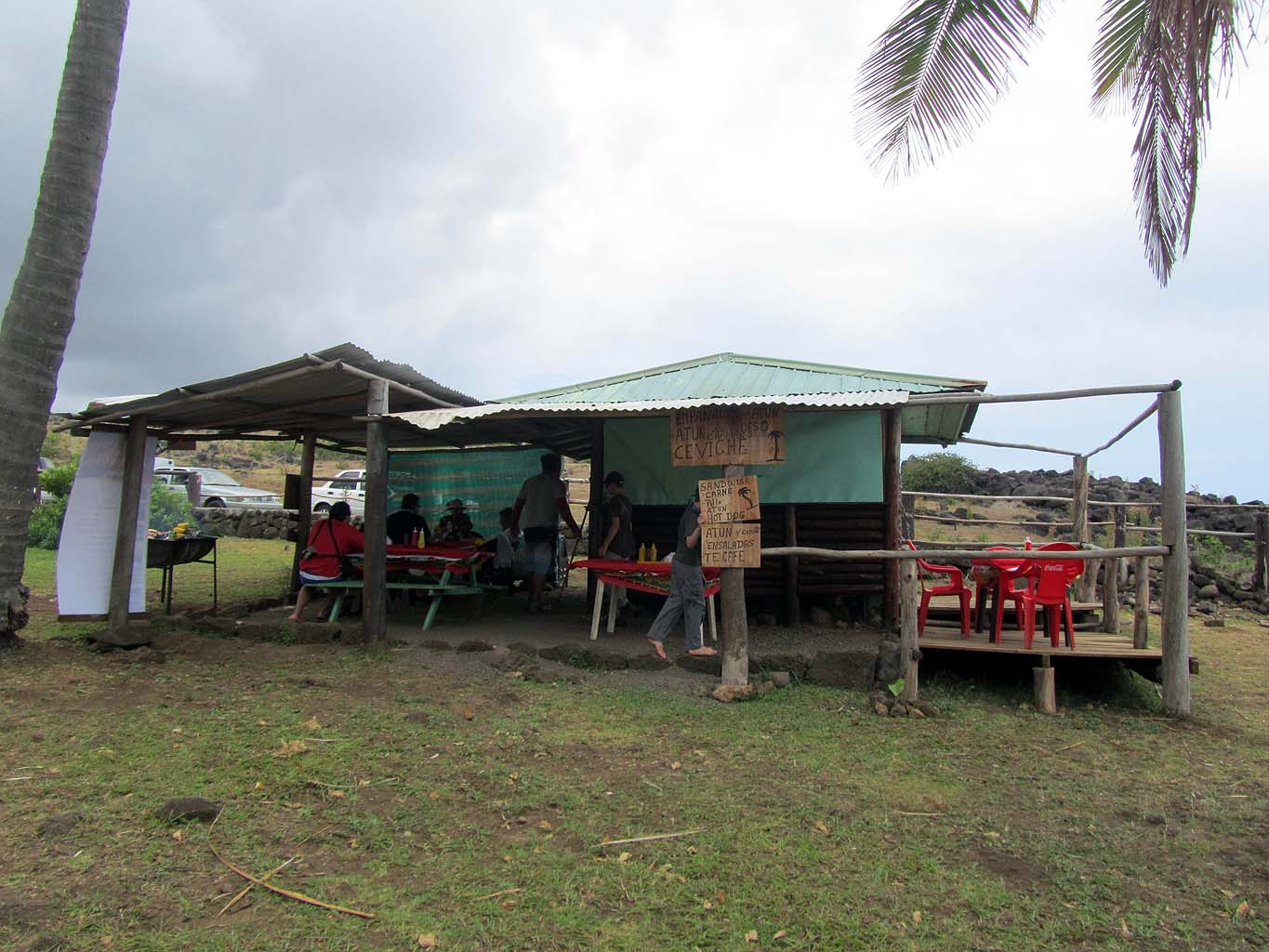
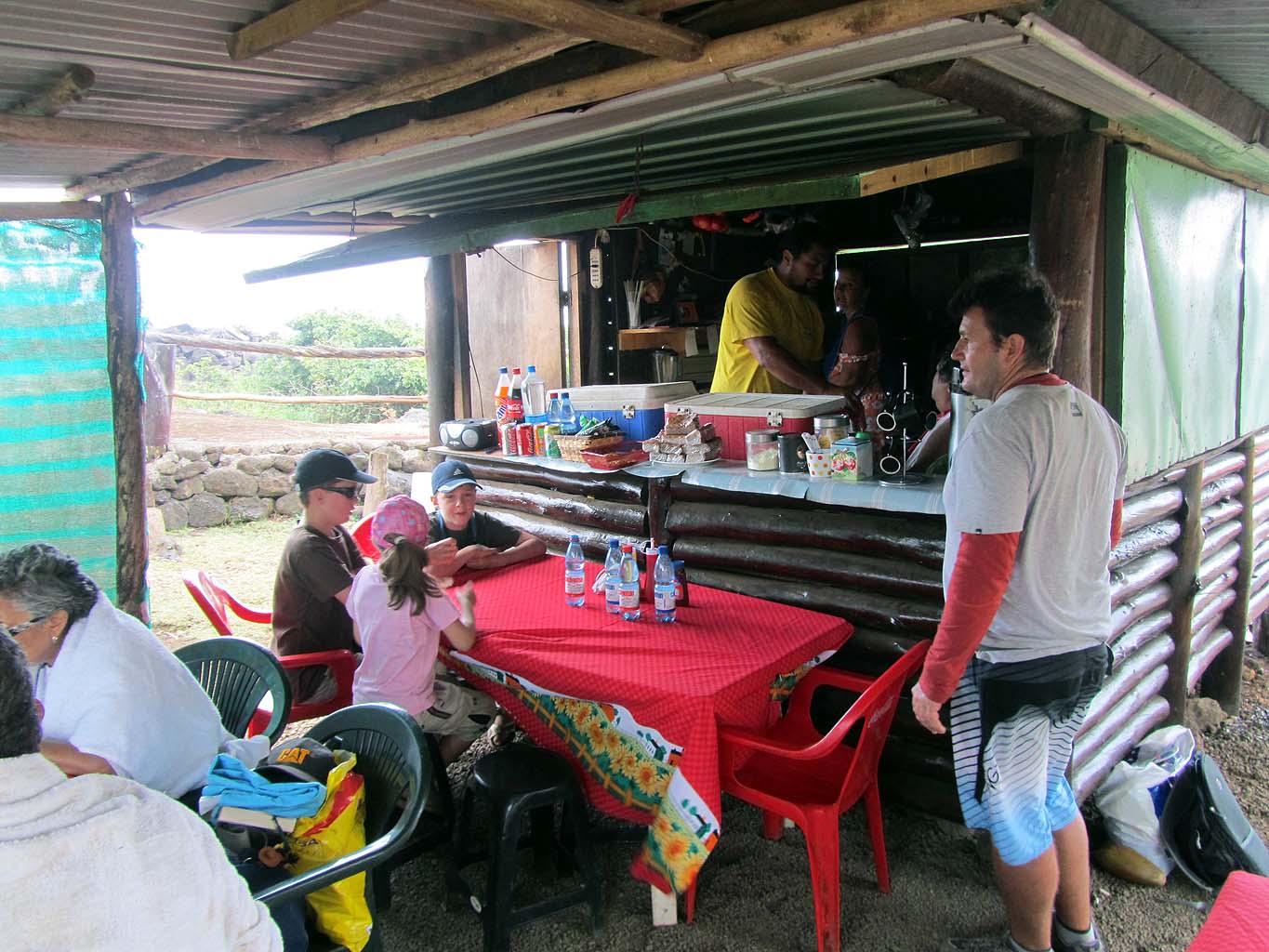
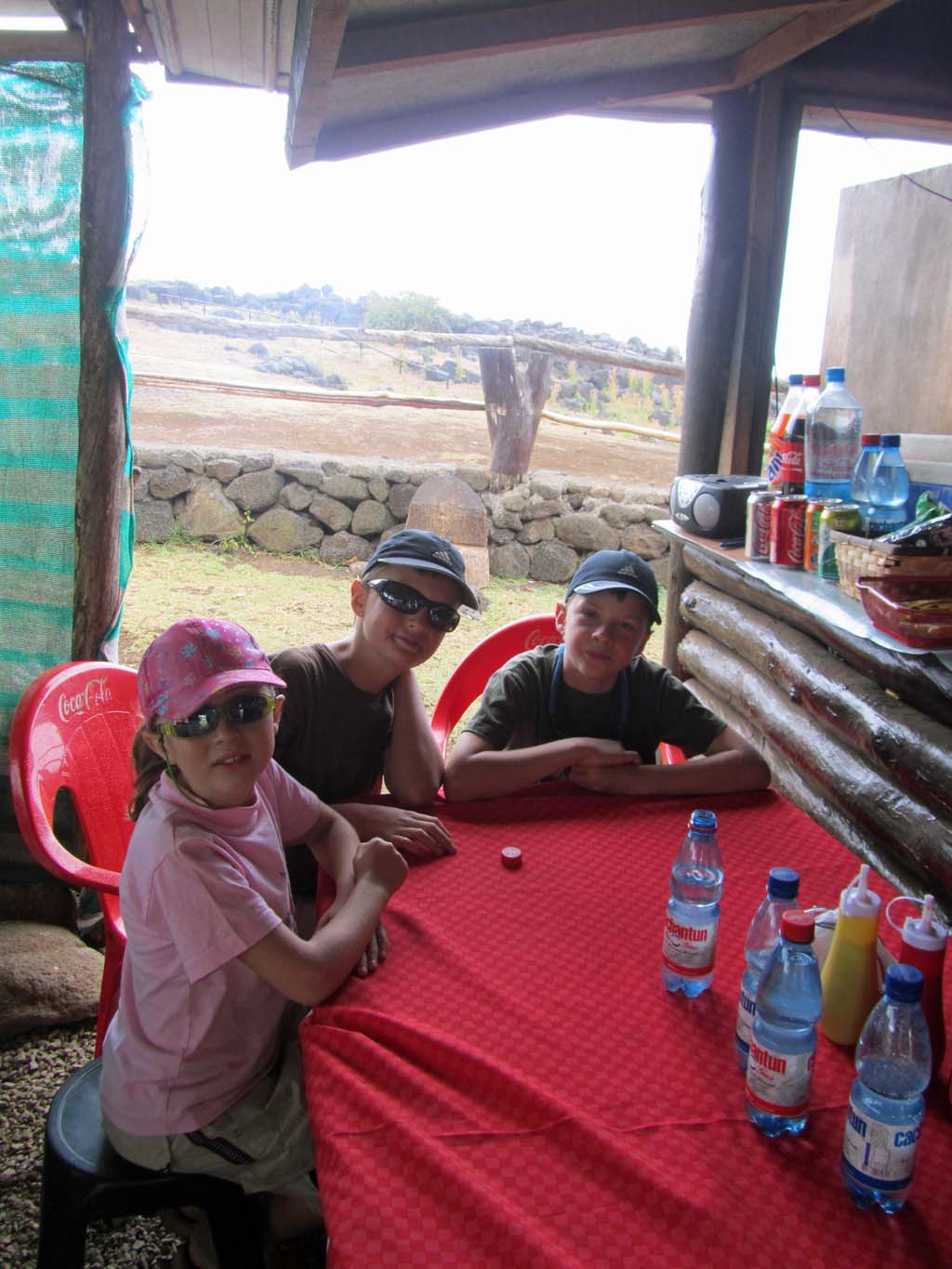
The kids enjoyed Anakena beach for a while afterwards:

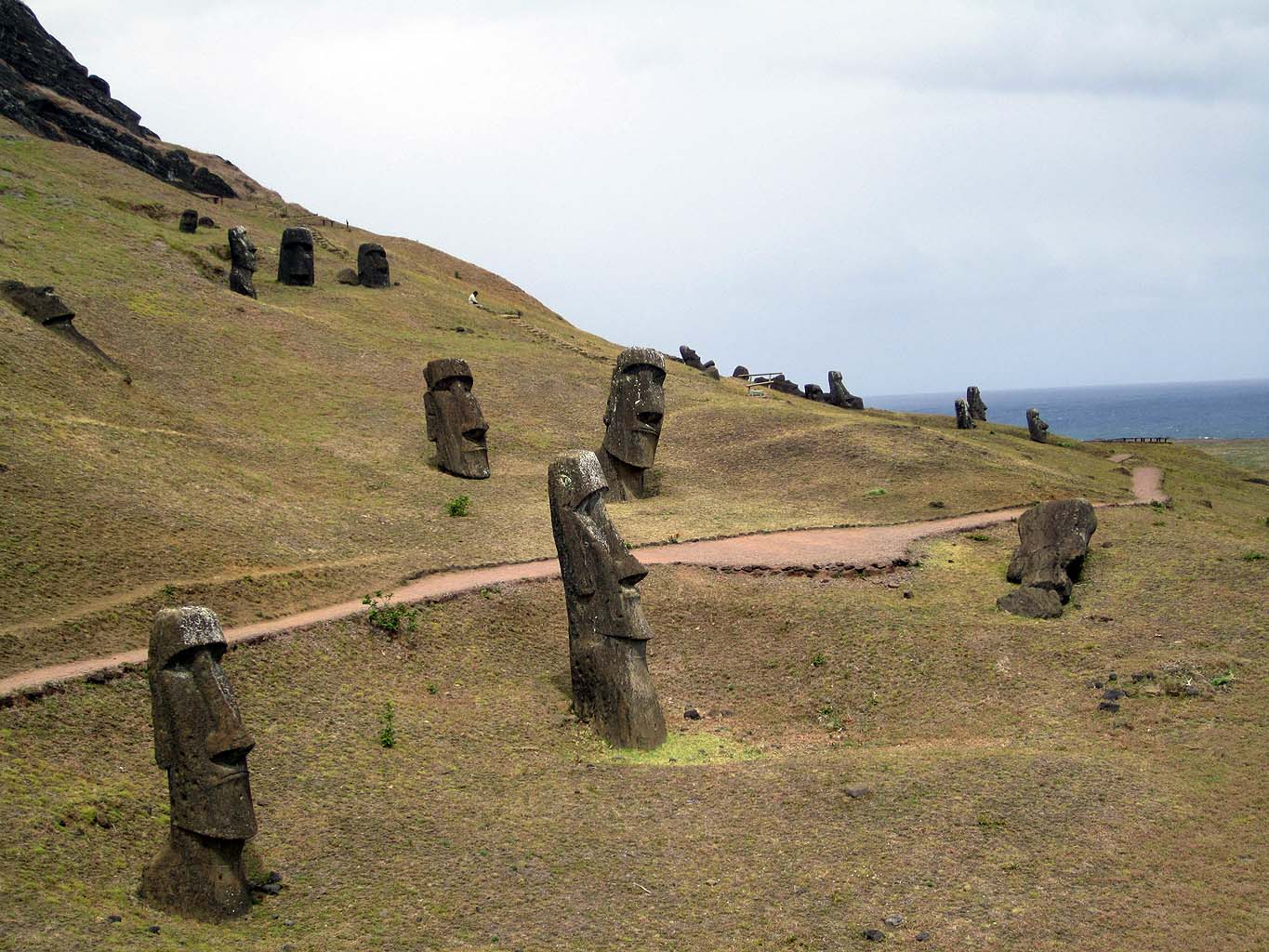
Next we drove over to Ranu Raraku, the quarry where almost all moai were made. Moai were ordered and created in the quarry while the chief it was going to represent was still alive. The moai would then wait in the quary until the chief was dead and first then would it be transported to its final destination. Of the 887 known moai, 394 are still in the quary. As Easter Island siciety collapsed there were no longer any resources available for, or interest in, moai transport.
It was a very special feeling to walk among these gigantic “gravestones”. Centuries of erosion and sliding soil have buried the torsos of most of them:
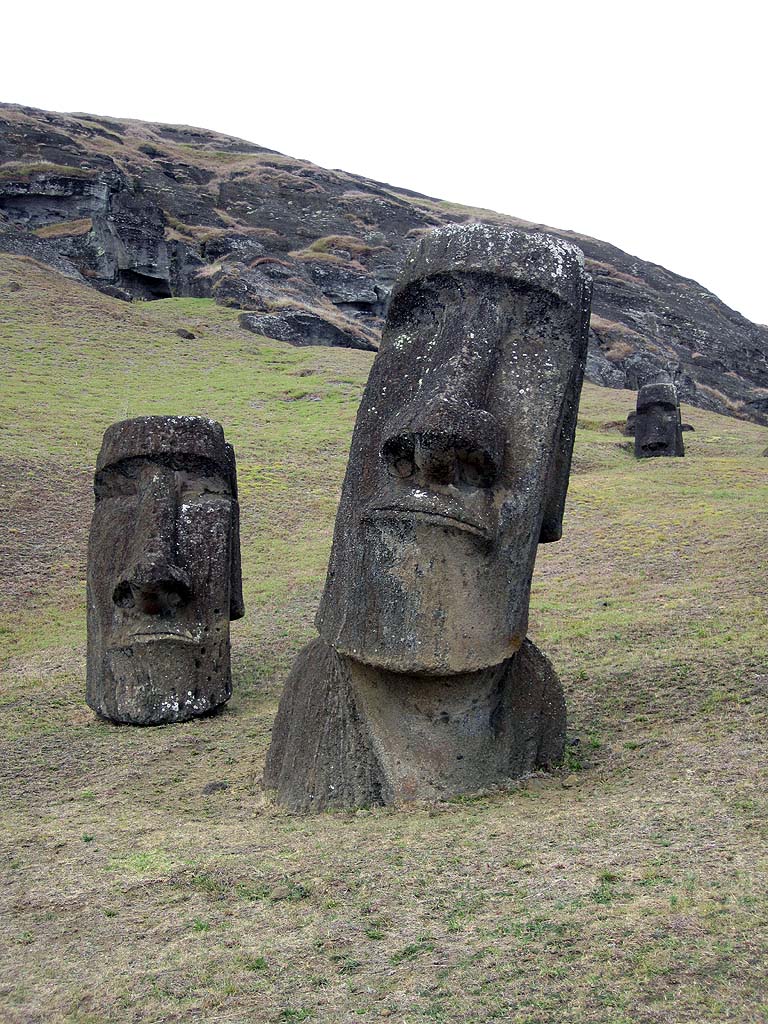

Notice that the eye sockets are not carved out. The eyes, more than anything else, represented the mana (the social and religious power) of the deceased. The eyes were only made after the moai was well in place on its ahu. The eyes were then filled with white corals and obsidian pupils. This was only recently proved and discovered and none of the restored moai have their eyes filled, except one, where the eyes have been painted. It gives an idea of what the moai must have looked like to the Easter Islanders and the impression they must have given:
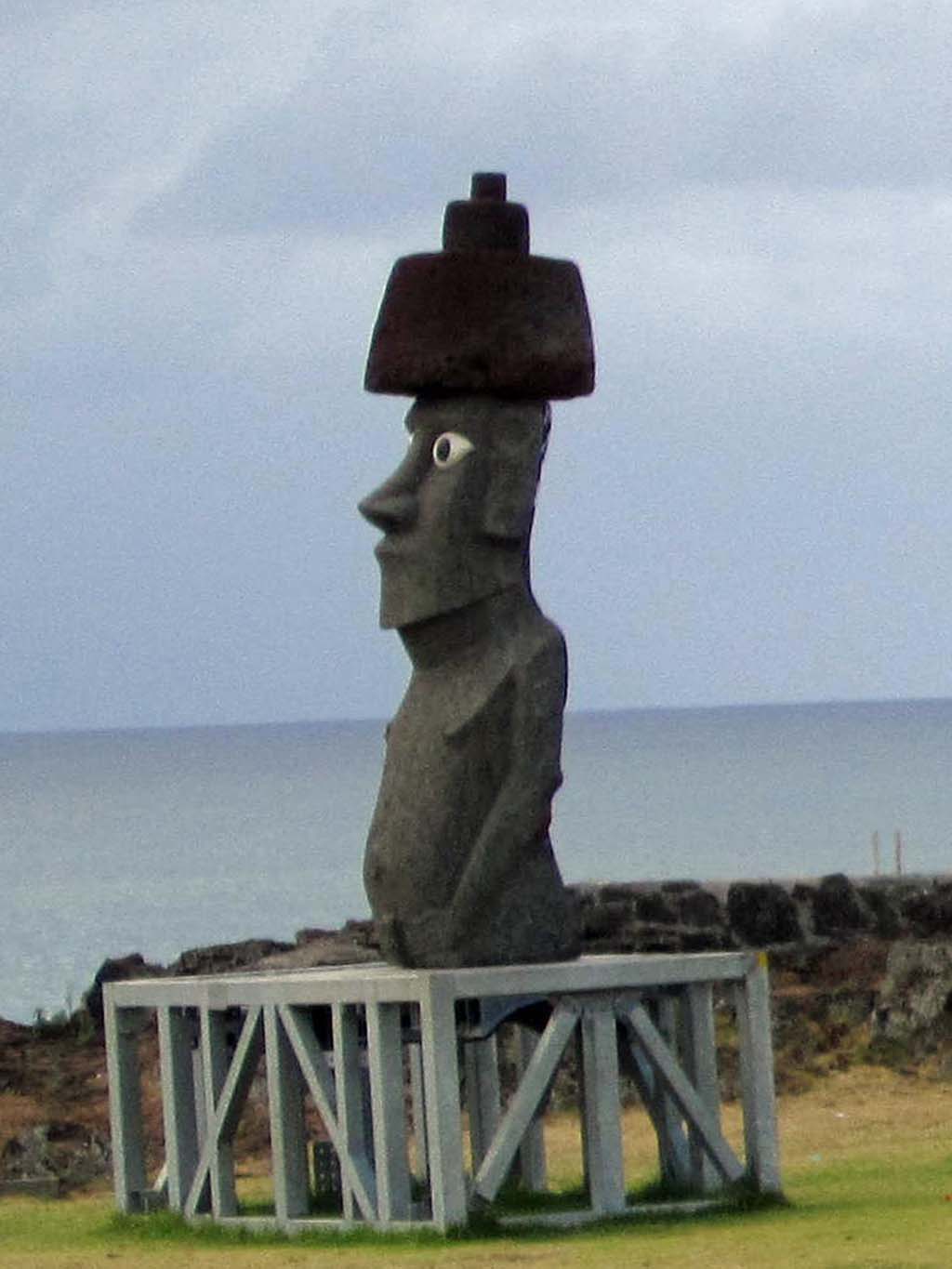
These majestic statues were a result of years of work and use of then current bleeding-edge technology by order of the ruling class. They must have had a deep impact on common people. It reminds me of the large Cathedrals built in Europe at roughly the same time. They took decades to build and must also have had an immense impact on common people.
We could clearly see where moai had been taken out of the volcanic rock
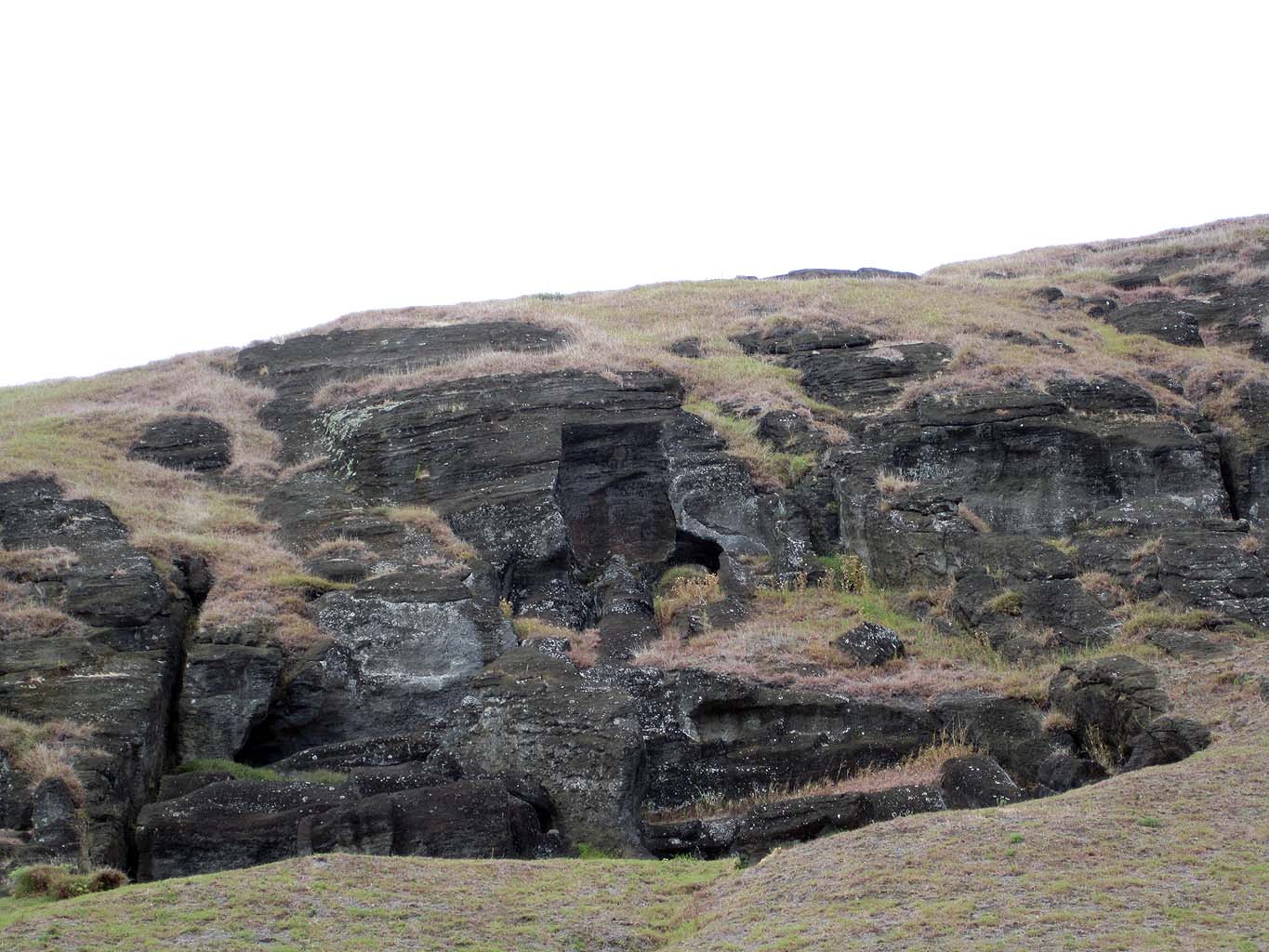
The quarry looks like it was left in a hurry. There are staues in all different phases of construction.
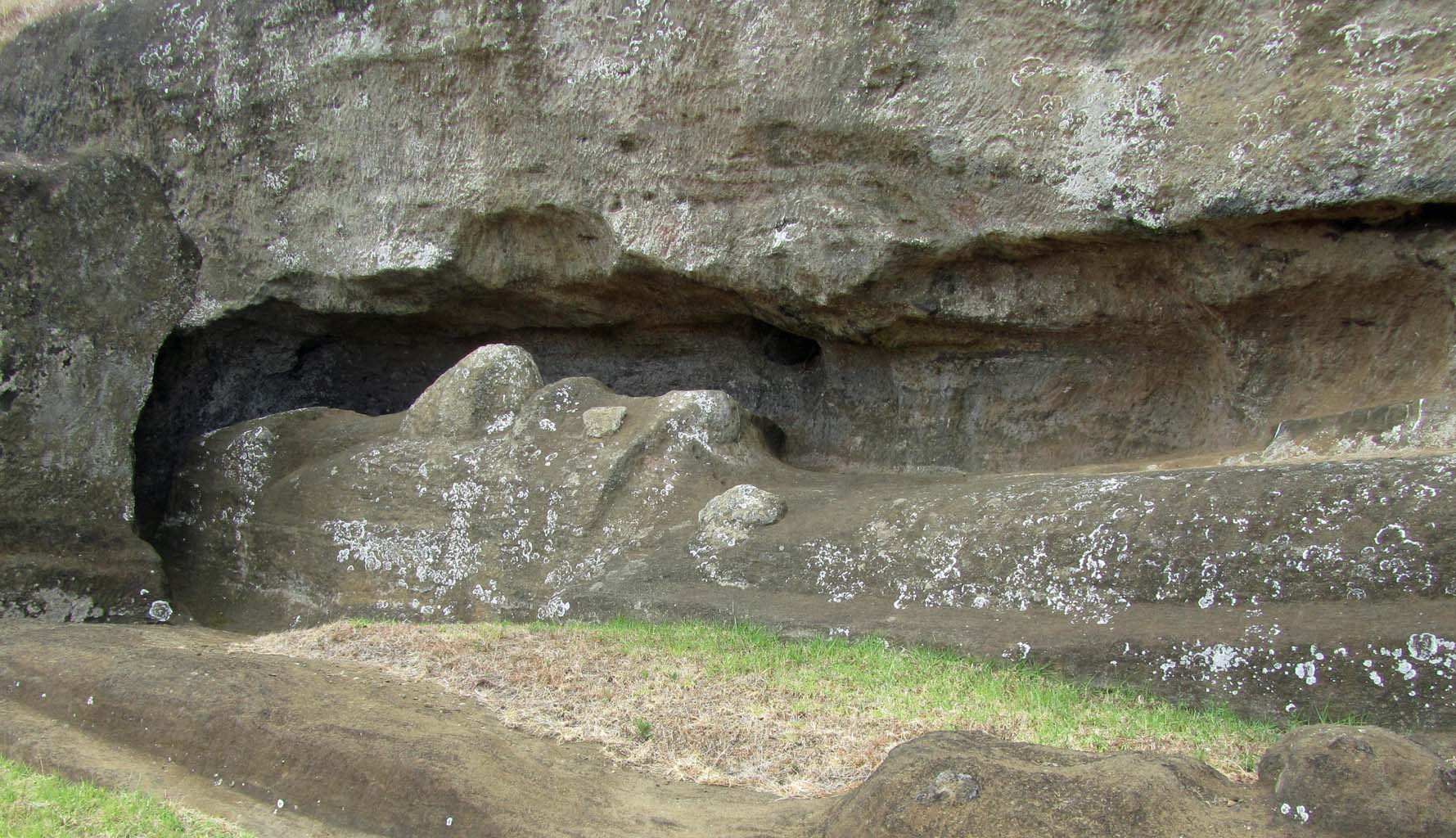
The tools they used to carve are still lying around:
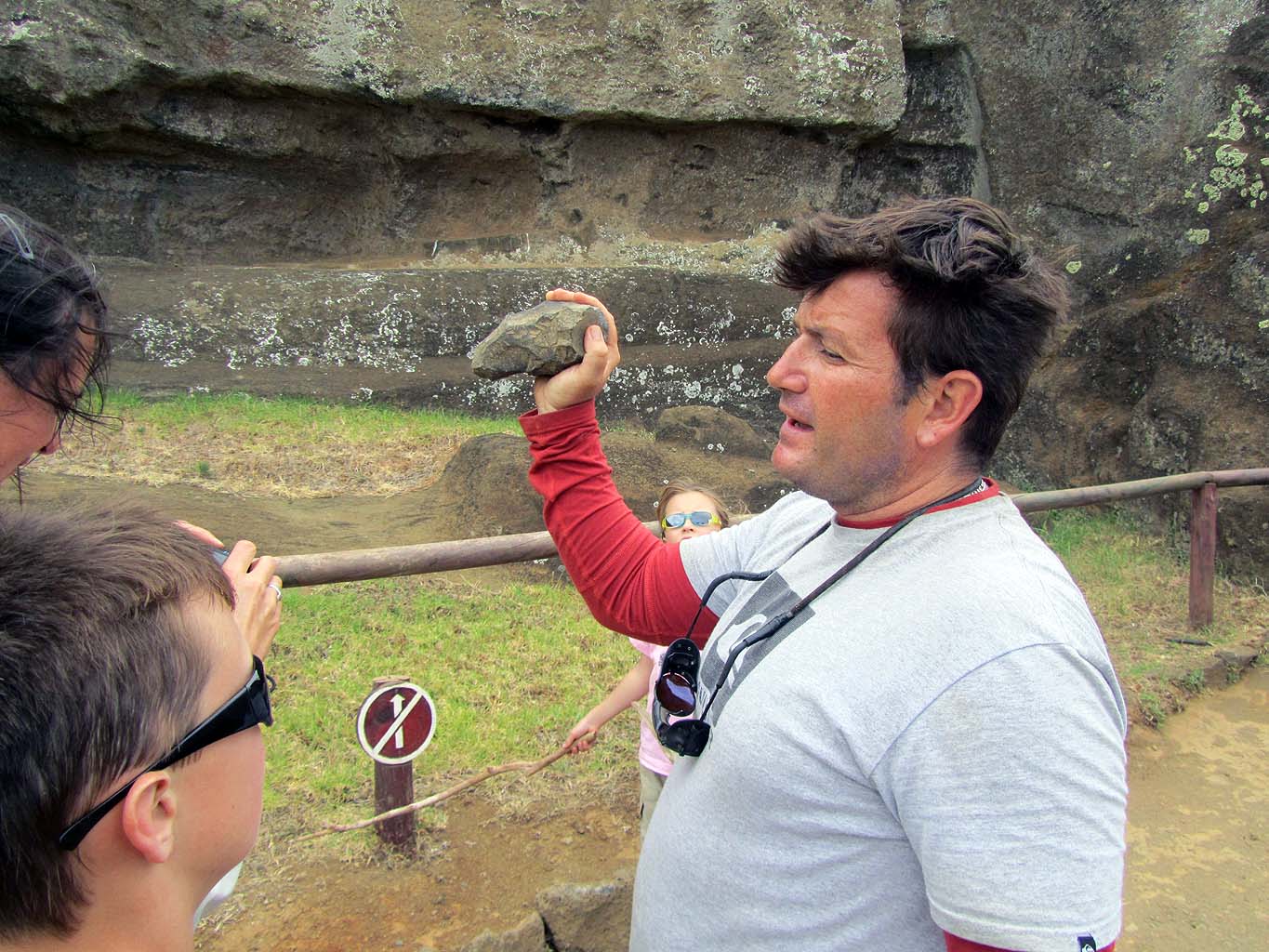
Carving was done with hand-held rock tools. One of the reason the Easter Islanders could excel in their rock carving was because of the exceptional quality of the rock here. It was soft and easy to carve, yet did not easily brittle.
This is the largest moai in the quary:
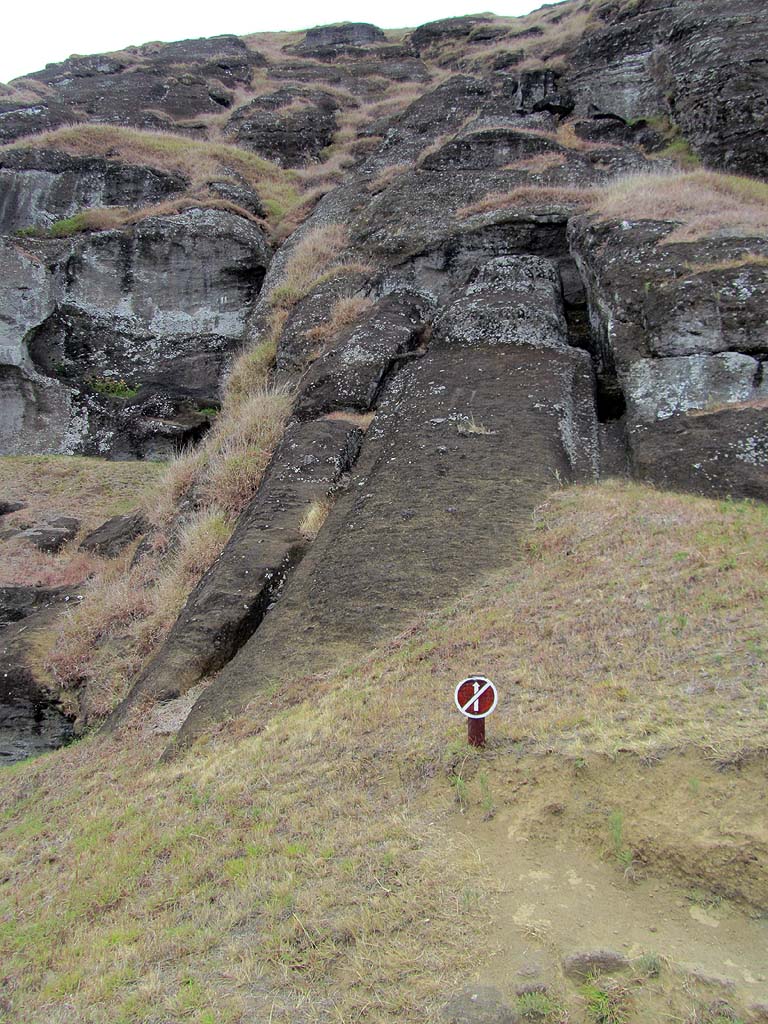
It is 21.6 meters (72 feet) tall and weighs about 170 metric tons The largest moai erected was 10 meters (33 feet) tall and weighed 74 tons. With what we know today about their technology it is pretty clear that it would have been impossible to erect this moai with the available work force on the island. Megalomania seems to have reigned. In general moai became taller and taller over the centuries. The 54 different clans on the island were probably engaged in a show-off of power. Hah, you think your 74-ton moai is impressive? Just wait until you see the 170-ton one I have ordered in the quary.
During the moai construction years more and more of the islands resources were used for their production. Intensive agriculture held the system alive for centuries, but as soil erosion caused by deforestation washed more and more fertile soil into the sea the tipping point was reached. Moai would give a clan more mana, and mana would give a better harvest and more food to the clan. There we have that religion thing again. Instead of using their time and energy on maintaining and optimizing their resources the islanders focused more and more on ahu and moai building.
As harvests and food resources in general became scarcer Easter Island society changed dramatically. People started to lose faith in their religion, the priests promised more food, but people got less.
At some point the power balance shifted and the priests, who had ruled the island for centuries, had to leave the power to the military. Easter Island came under military rule by the soldiers of different clans who fought each other intensely over the few resources who were left. Clans winning battles would take what they could immediately use and destroy the rest. They would burn houses and destroy crops and fields, thus further diminishing the scarce resources on the island. The collapse of the island´s society had started.
In the 16th century the new military rulers of the island abandoned the old religion and created a new one which fitted their needs, the so-called make-make cult. This is often how religions have evolved, by fulfilling the needs of the ruling class to control the common people.
Basically the islanders went from a polytheistic (many gods) religion with ancestor worshiping to a pseudo-monothesitic (one god) religion closely related to fertility, spring and migratory seabirds.
After a period with many wars there must have been an understanding that the fighting had to stop. The solution that was introduced seems unique in human history. Once every year a competition was held. A young strong man from each clan entered the birdman competition. The first to swim out to a small uninhabited island off the coast and fetch an egg of a sooty tern, and return it safely to the starting point, would be the birdman and could decide who would be the supreme ruler of the island for the next year. This is probably the only case in history where a political leader was chosen to rule a people based on the results of a sports competition. The birdman solution stopped the worst fighting. Alas, the burning continued. The winning clan would often use its power to plunder and burn the property of others.
When the first Europeans arrived in 1722 there was not a single house left on the island. People lived in caves and small underground shelters.
Back in the quarry I was preparing to take the grand photo of the voyage; the family next to all the moai, when the sky suddenly dumped an unknown, but large, quantity of water on our heads. We had brought rain gear, but had of course left it in the car during the visit in the quarry. There was not even a point in running, we were soaking wet within seconds.
When we reached the car the boys and I told Christophe we really wanted to see the inside of the volcano crater. We didn´t care much if we were wet, it had been warm rain. We climbed up the volcano side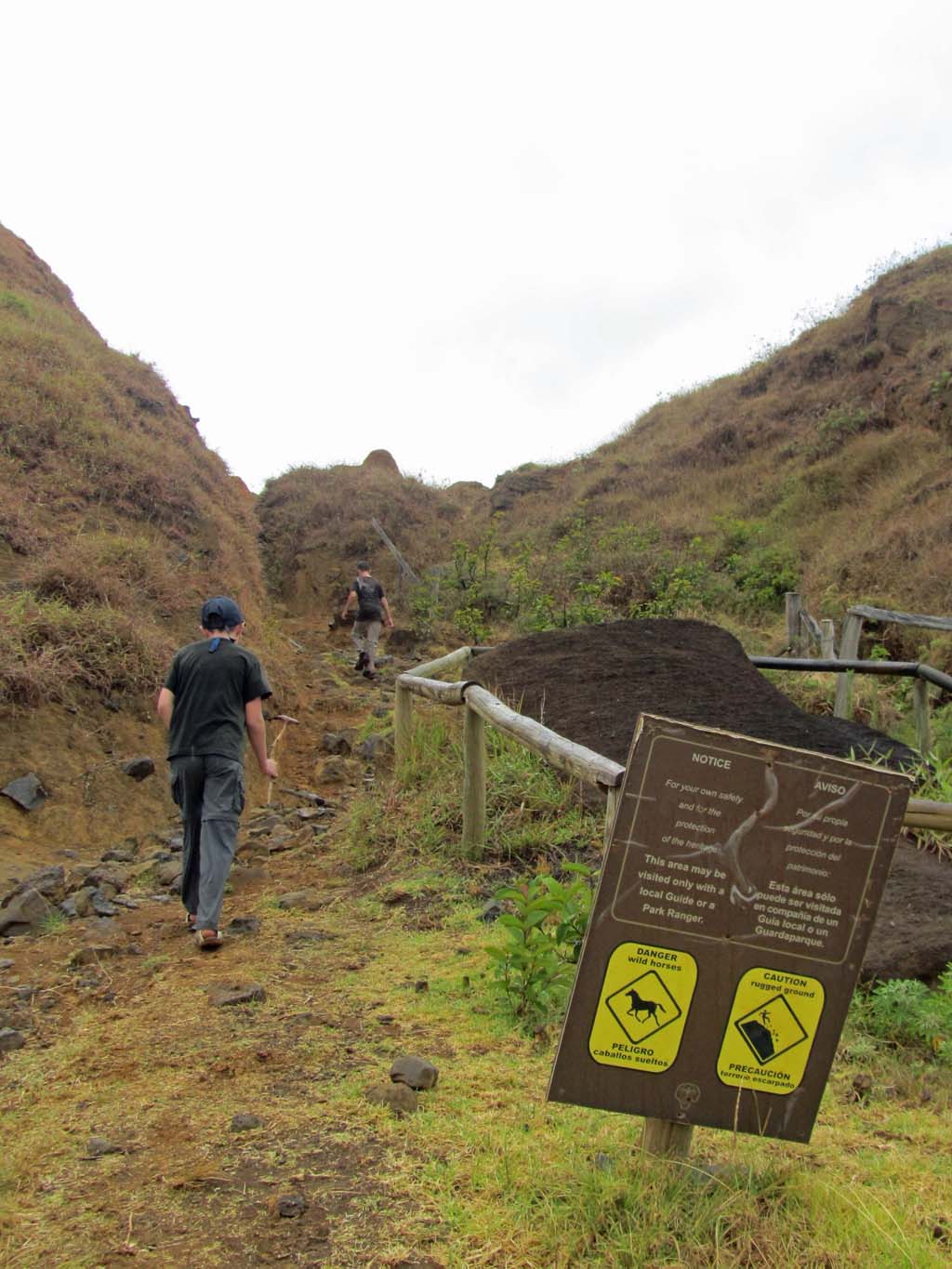
The sign says: “Beware of wild horses” and “No entry without a local guide.” On the inside there was a lake:
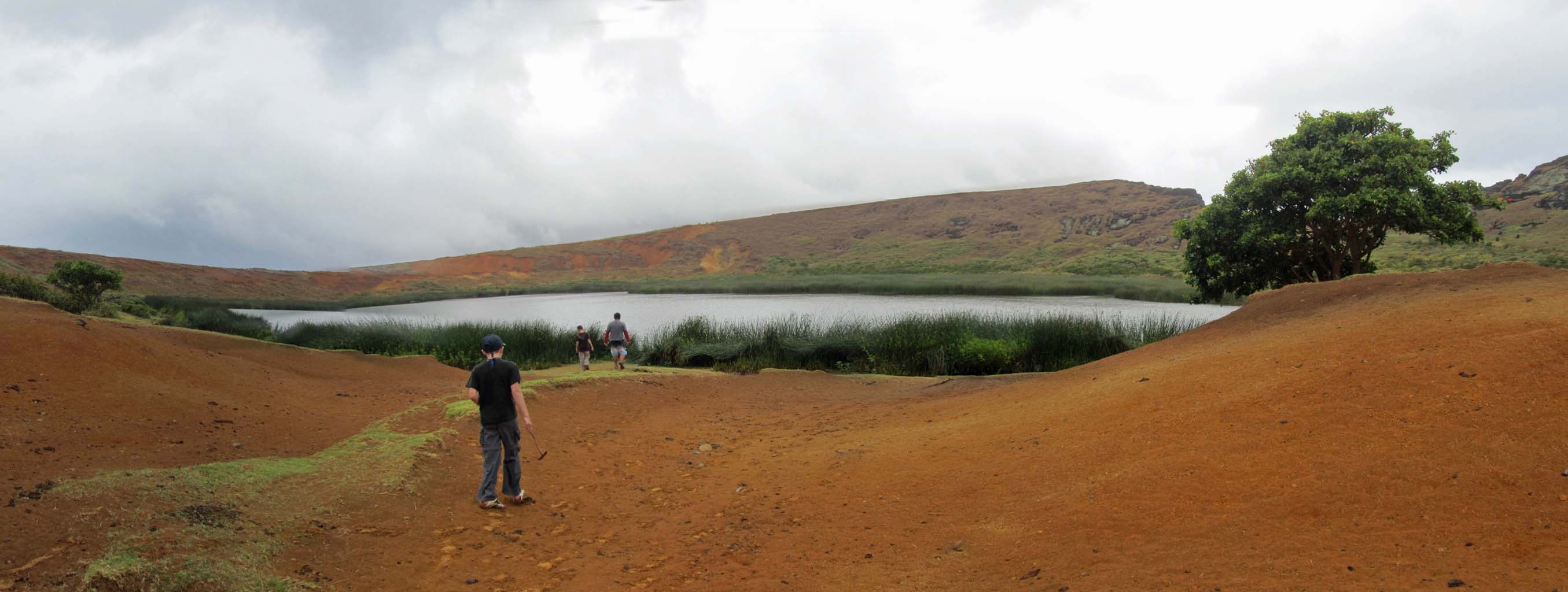
We were a bit disappointed, I guess we had expected something a bit more Lord-of-the-Rings-like. Still it was cool to have been inside a volcano crater.
Next we headed over to what is arguably the best known and most impressive of the reconstructed ahus: Tongariki. I had read about this place with its 15 moai. It was a special feeling to finally be there:
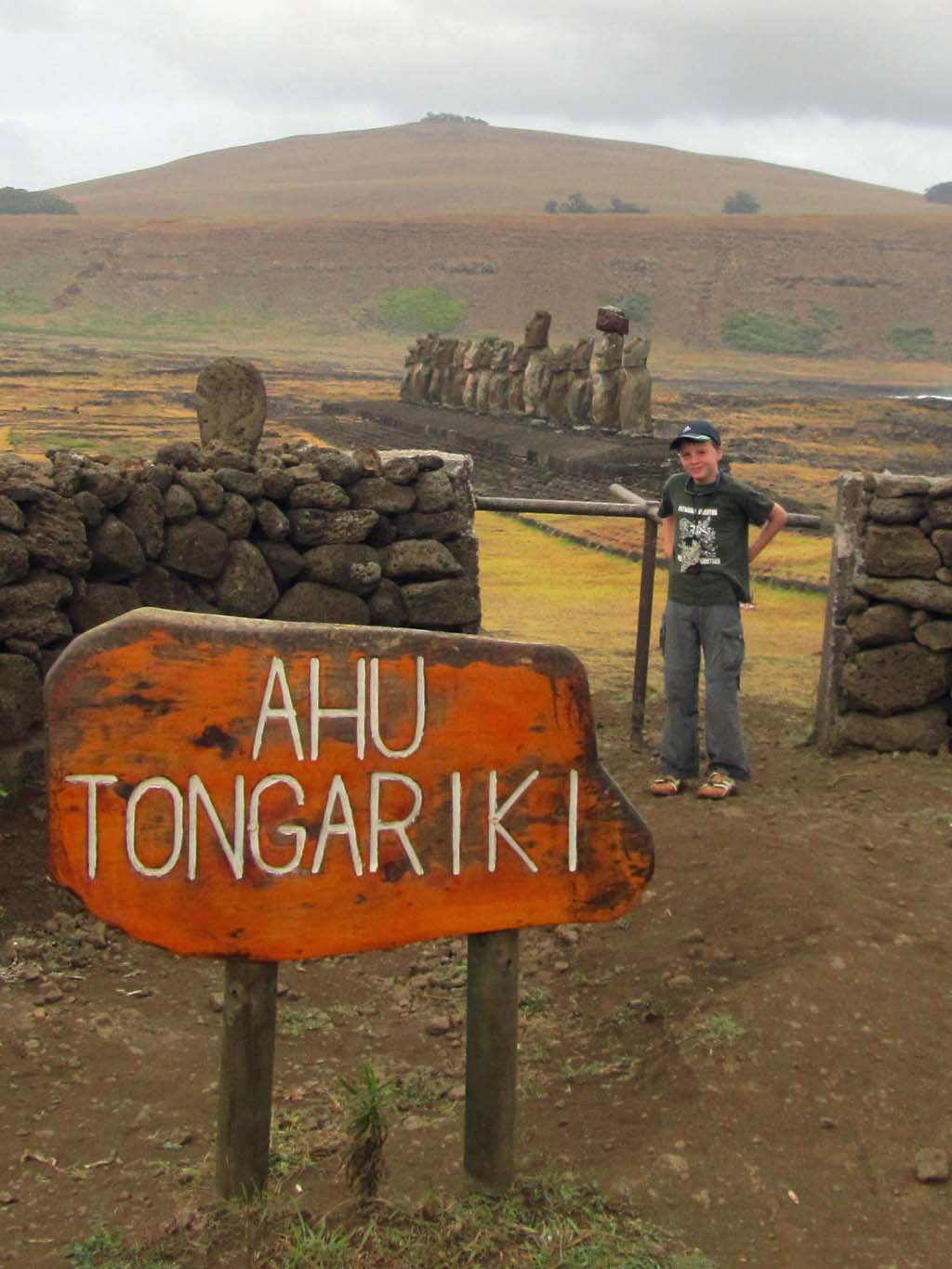
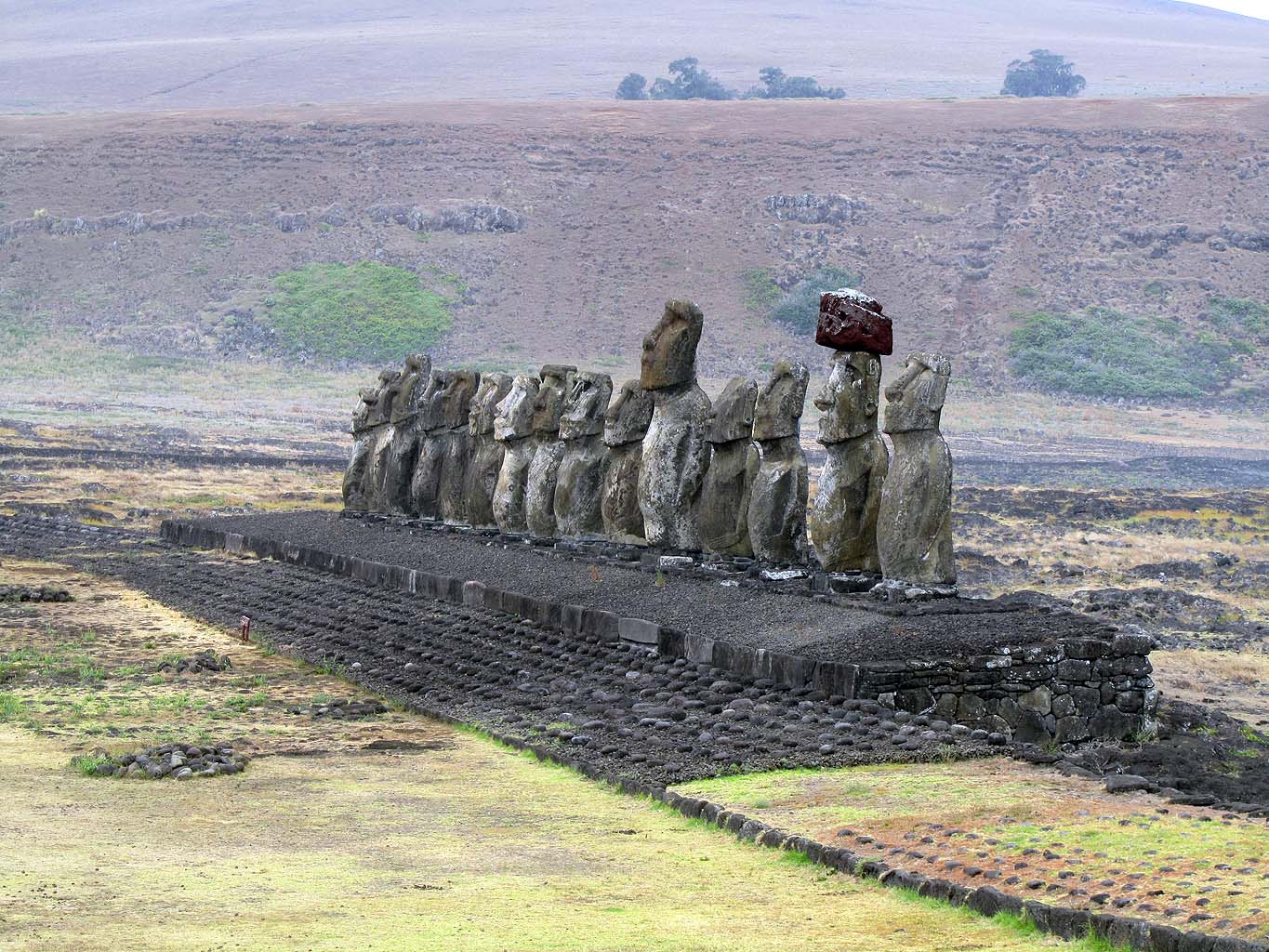
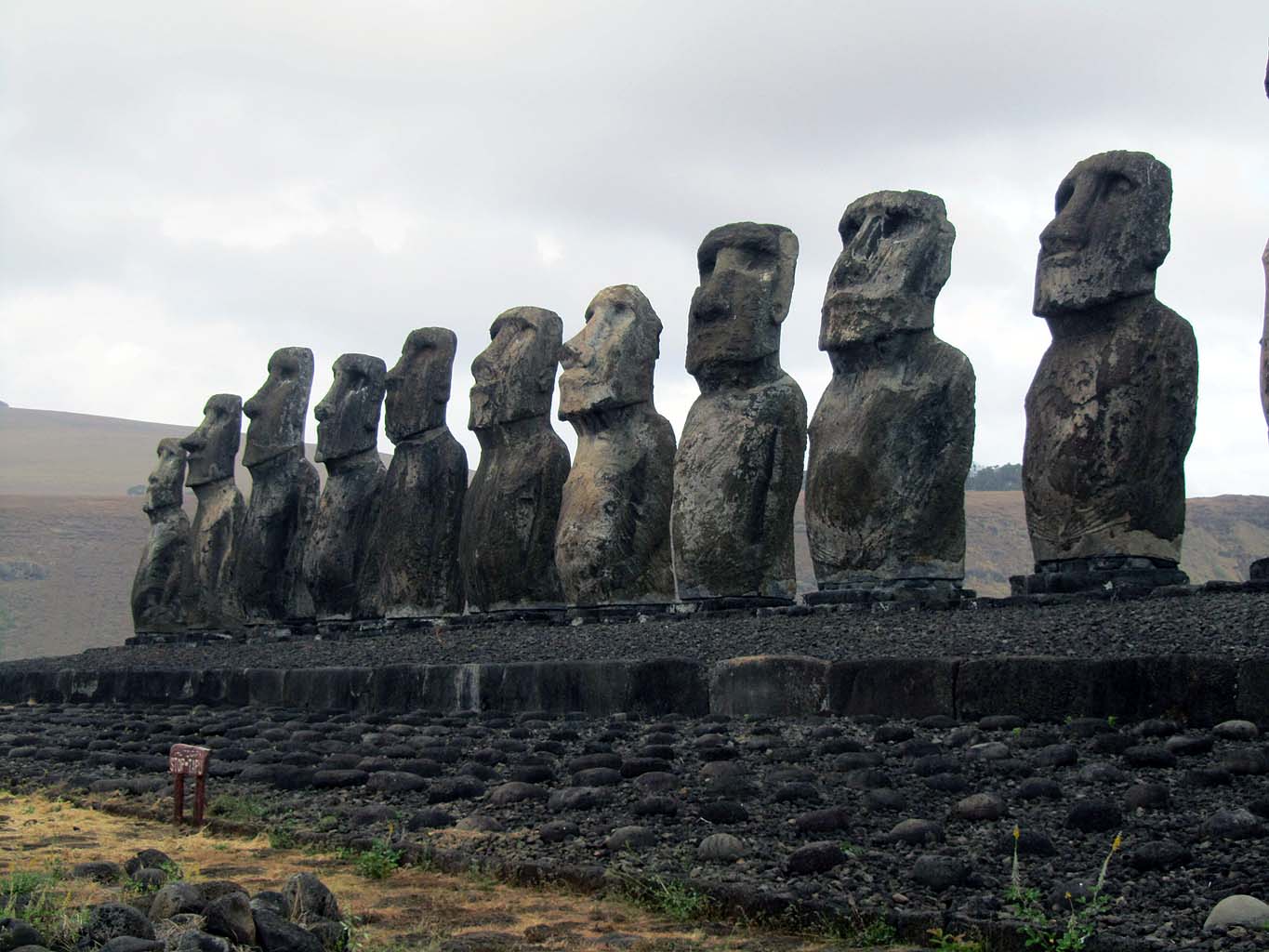
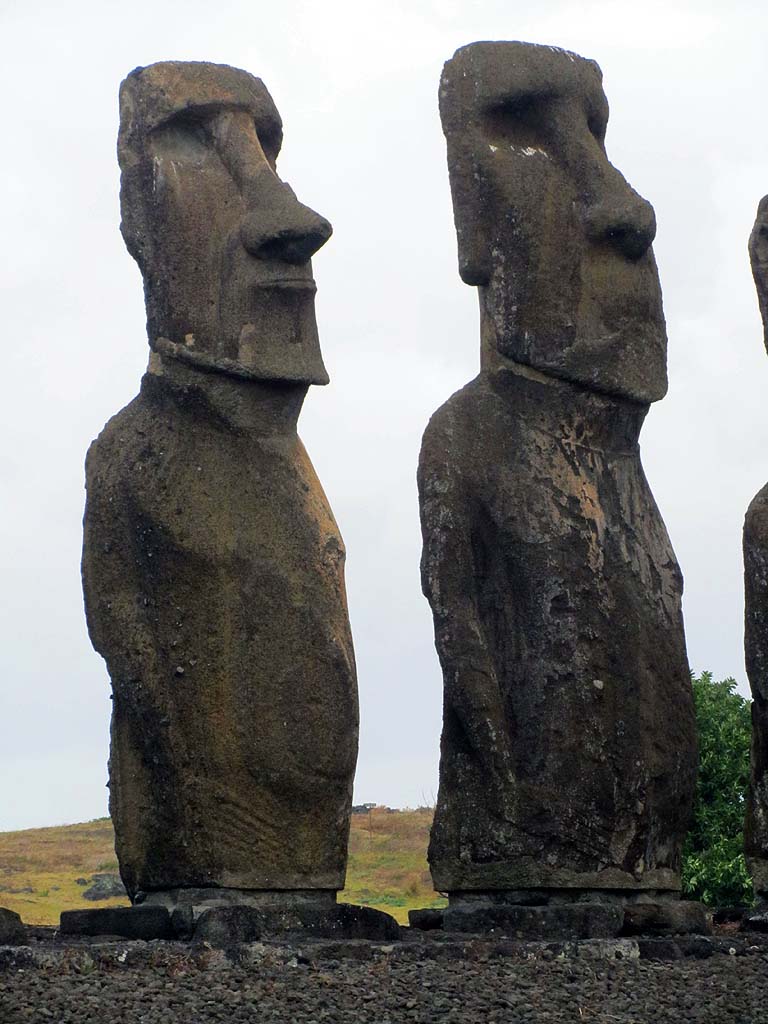
Tongariki was reconstructed by the Japanese Moai Restoration Committee (!) from 1992 to 1996. They were sponsored by a Japase crane company who donated two enormous cranes for lifting the moai. The Chilean government still demanded a heavy import tax on the cranes, which the Japanese refused to pay. This delayed the project by many months.
Even with modern lifting cranes they had problems with the largest moai, which was the heaviest one that had been erected by the islanders, at 86 tons, but prevailed in the end. The plan was also to put in place many pukao (top-knots), but they only succeeded with one. The others are still lying close to the ahu:
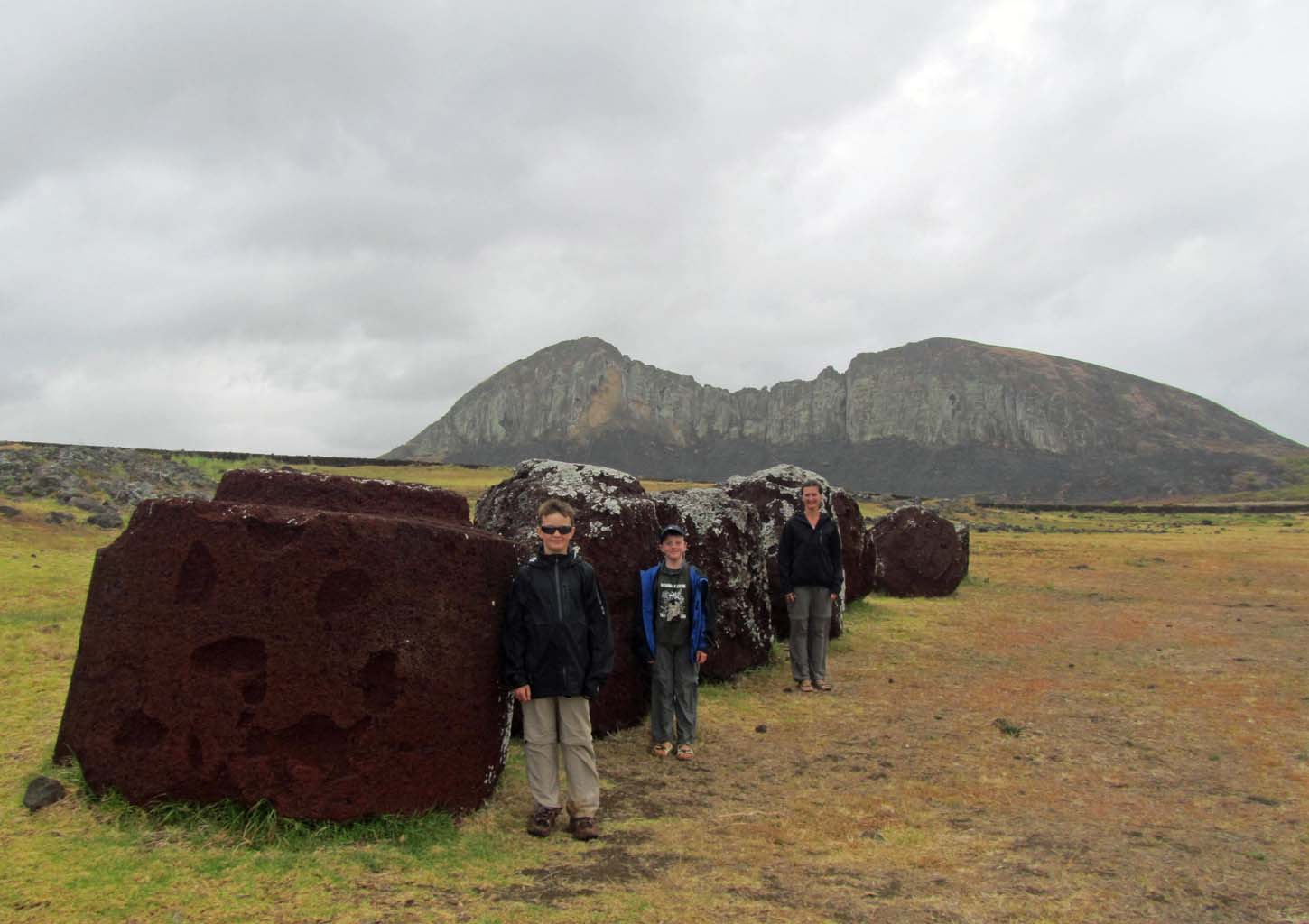
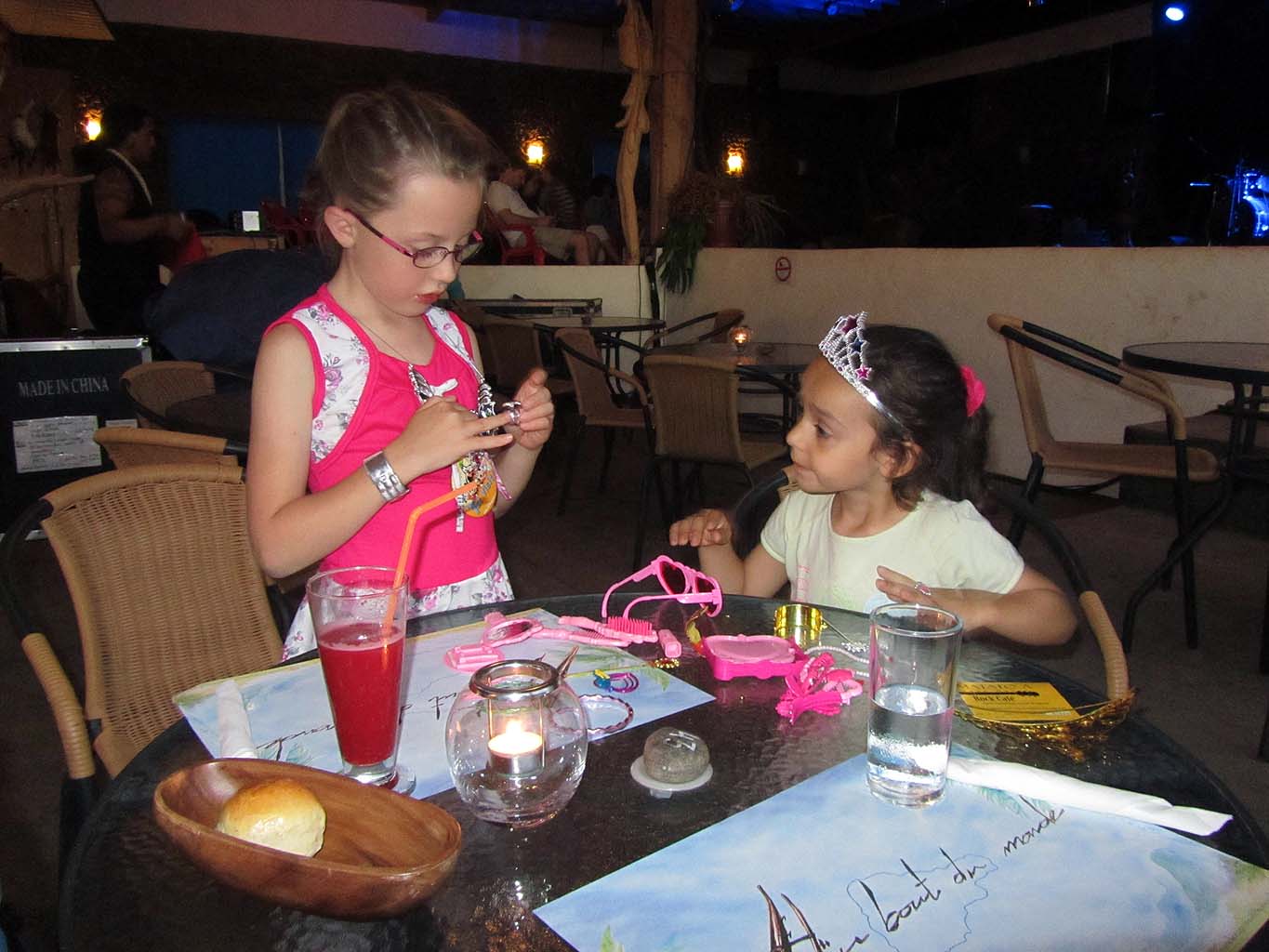
After a full day admiring ahus and moai we had dinner at a restaurant run by a French couple. Iseline had a great time with their daughter:
They had real French chocolate mousse! As always I had to sample the local mousse in the name of science:
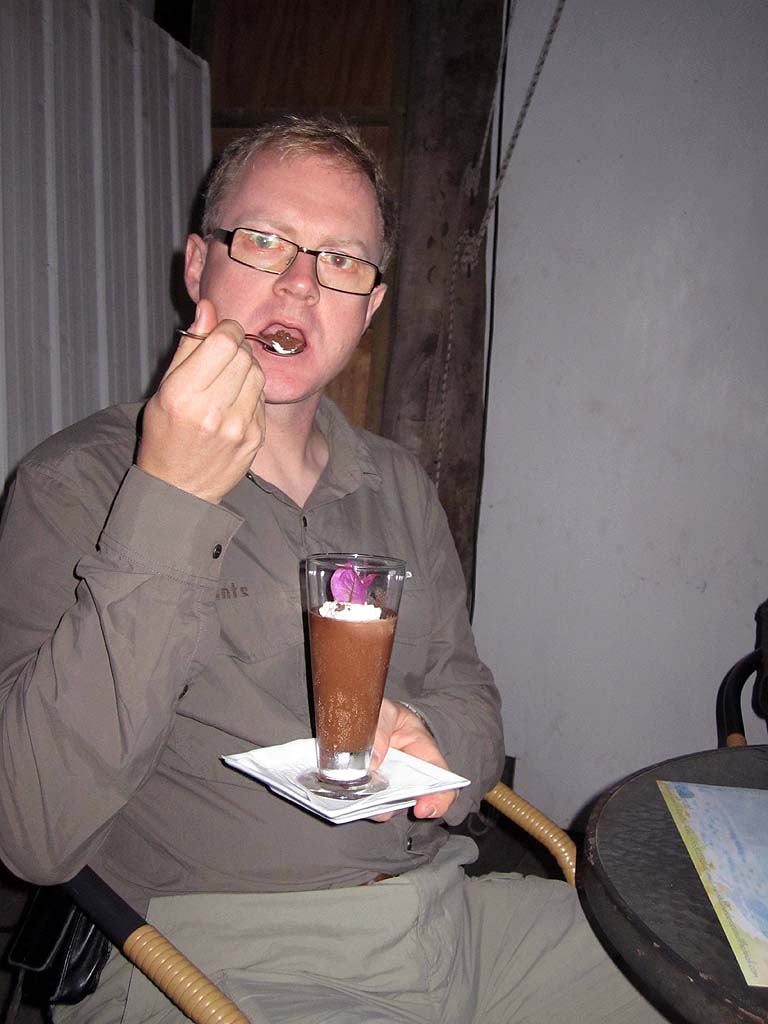
It was not bad at all.
After dinner there was a traditional Polynesian dance show on the stage in the restaurant
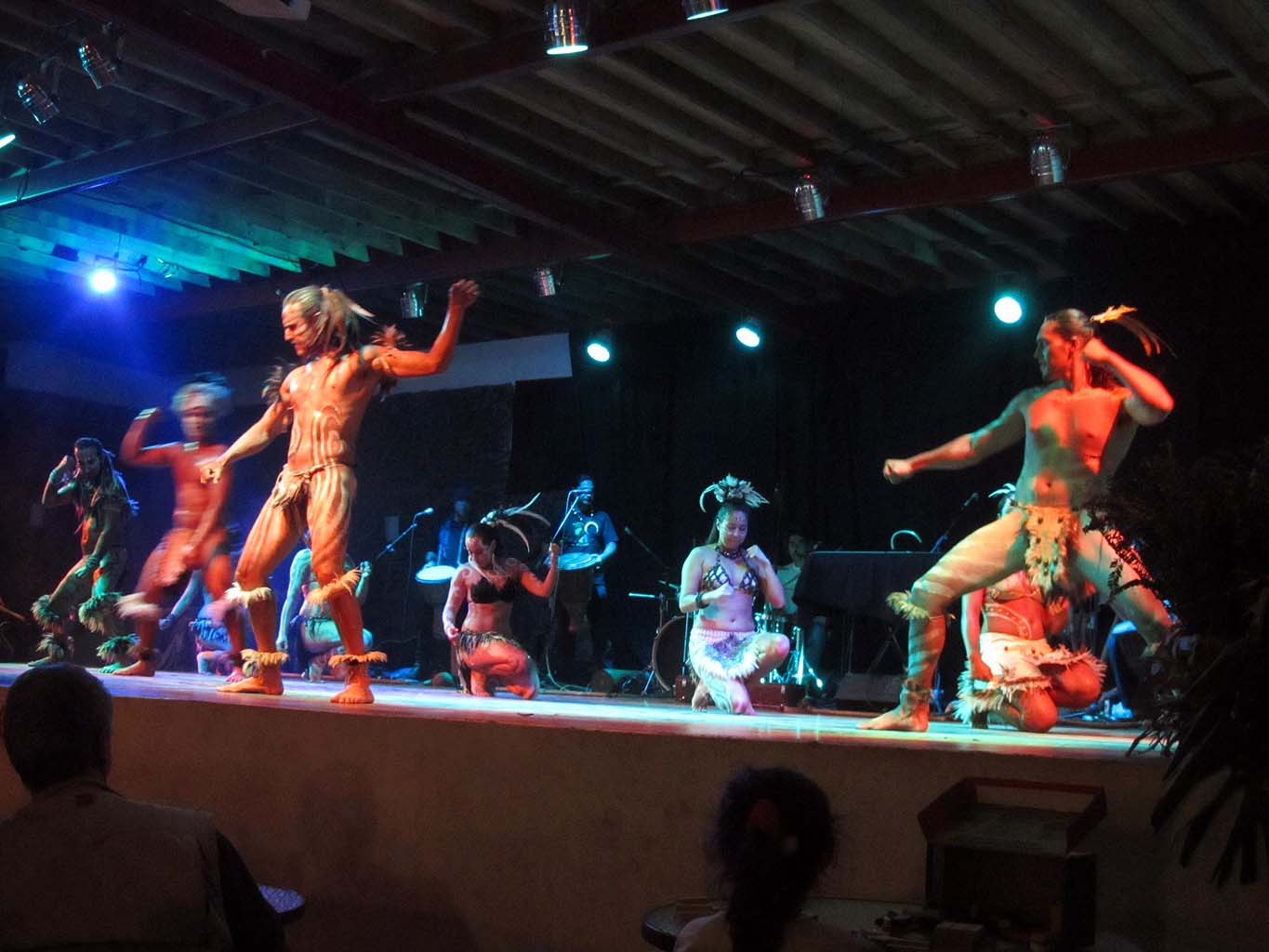
Warning: Tourist photos!
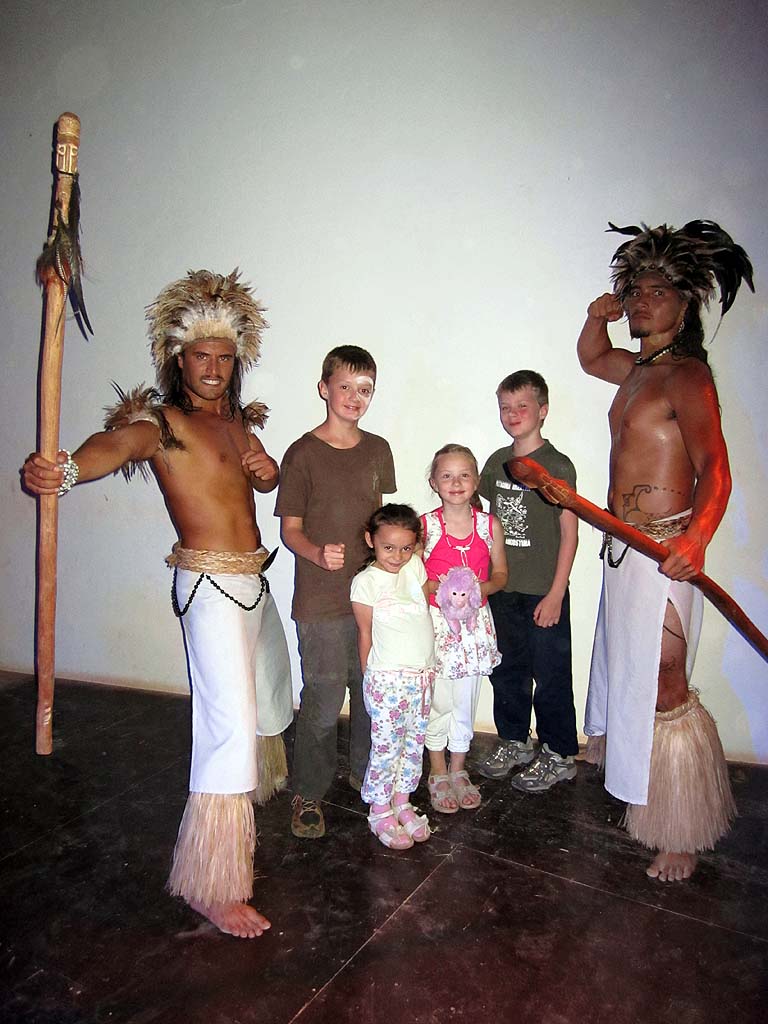
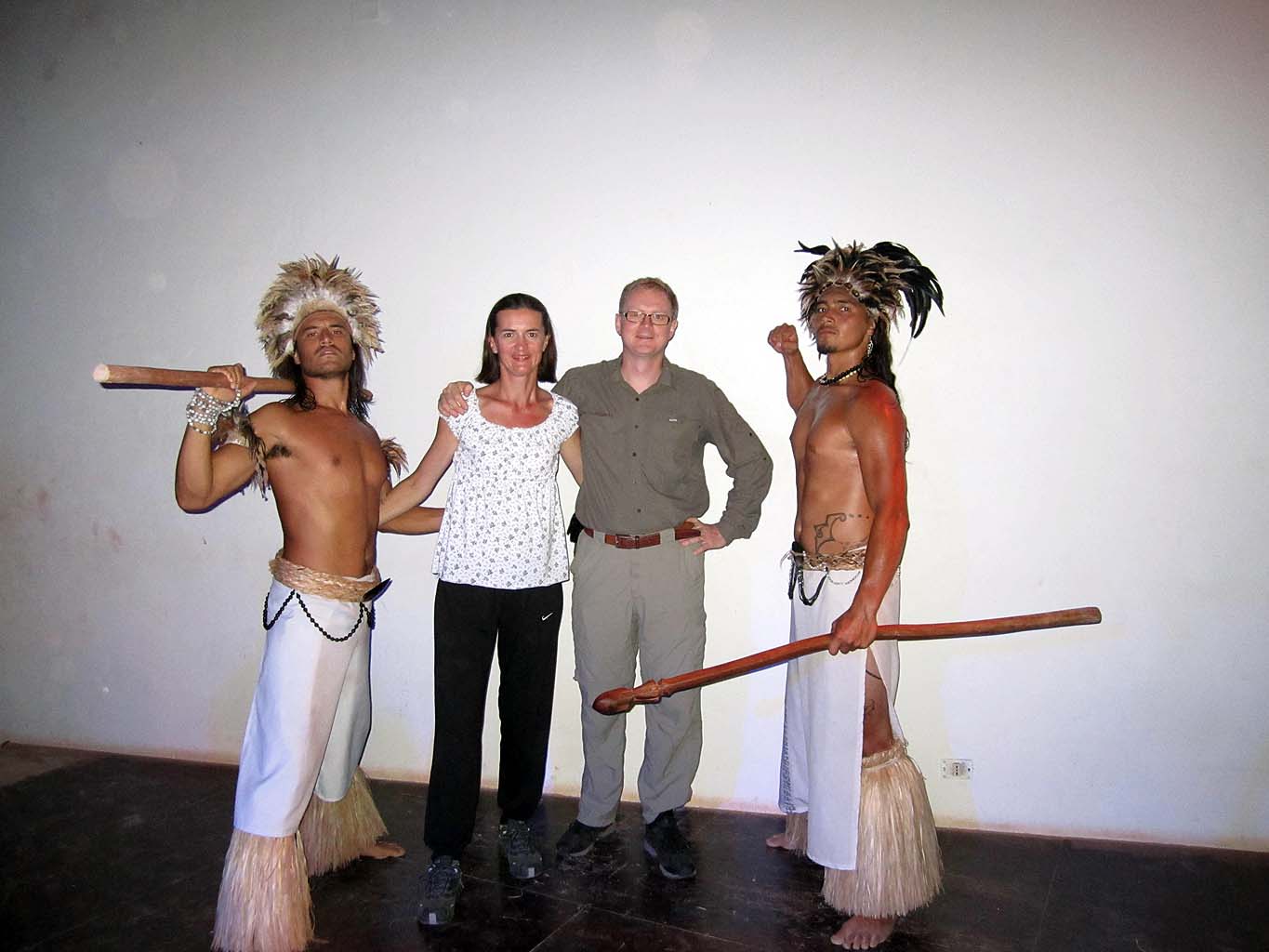
What a day it had been! With the added benefit of the time difference we fell asleep early knowing we had another day of Easter Island discovery ahead of us tomorrow.
Eirik
—–
