




Rarotonga – The Island
January 29, 2011
Our last full day on Rarotonga we took a tour of the island by car.
There is one main road here, which follows the coastline. There are two bus lines on the island, the clockwise bus line and the anti clockwise bus line

In addition to the main road there is also a small road which circulates the island a few hundred meters inland from the main road. It is called the Are Metua, and was built by the Polynesians about a thousand years ago. It used to be a showcase of Polynesian engineering. 29 km (18 miles) long and 5 meters (16 feet) wide it was paved with basalt and coral stones until the Americans covered the road during the second world war. It now looks like any small rural road.
Unfortunately it was raining vey hard, so we got to see the interior of the island in its wet look.
A typical Rarotongan house:

There is virtually no poverty to be seen on the island, people are enjoying a rather high standard of living and it seems to be fairly evenly distributed. The financial support from New Zealand must have had the intended effect.
Earlier we had bought our snorkeling equipment in a shop in Avarua. I love trying to guess people’s nationalities from their English accent, and the guy serving us had a very Scandinavian type of accent. I was pretty sure he was Swedish, but he could also have been from Norway’s border area with Sweden. Swedish and Norwegian are so close they would have been considered two dialects of the same language in other parts of the world. German spoken in southern and northern Germany are further apart, in my opinion, then Norwegian and Swedish.
Before I could ask the question Adrian made a comment about something in Norwegian and the guy switched over to Swedish. He was in fact the owner of the shop and had lived on Rarotonga for almost all his life. His father had come here in the early seventies and fell in love with the place. He obviously loved being able to speak Swedish and we got royal treatment and a good discount on our purchase.
When we asked him if he liked life on the island we got a different answer than I expected. He used some time to think then said that he was starting to get used to it and enjoyed it more now as an adult. Again we were surprised when he said it had nothing to do with the “paradise island” flora and climate. No, what he was starting to enjoy more and more was the relaxed atmosphere and the slow pace of life here.
As a child it was rather boring to grow up on Rarotonga, he said. The island is small and there is not much more than beach, swimming and snorkeling going on.
There were many flame trees:

We passed lots of churches. The ratio of churches to people on Rarotonga must be one of the highest in the world. It is interesting to see how many Polynesians on all the islands we have visited so far are more catholic than the pope. The missionaries who have worked in the Pacific during the centuries have been successful beyond their wildest dreams. It is especially ironic on the Cook Islands, which used to be a part of New Zealand.
I found numbers on the net from the 2001 census:
On the Cook Islands 55.9% are members of the Cook Islands Christian Church (spinoff from the London Missionary Society) , 16.8% are Roman Catholic, 7.9% Seventh Day Adventists, 3.8% Church of Latter Day Saints, 5.8% other Protestant.
As you can see, many different missionaries have had a field day here.
4.2% have other religions, 2.6% unspecified and 3% none (2001 census).
In New Zealand, on the other hand, the old mother country, more and more people are starting to realize that there probably isn’t a great spirit in the sky after all.
In the 2001 census 58.9% reported that they were Christians. Next on the list was 29.6% with no religion, then 6.9% objected to answering(!) Next, and this is quite amusing for an old Star Wars fan like myself, is Jedi with 1.5%. the Jedi beat the Buddhists and the Hindi, which both came in at 1.2%!
It turns out there was a semi-organized campaign ahead of the census in the old British Empire where people were asked to fill out “Jedi” as religion to protest against the question being asked. Jedi populations popped up all over the Commonwealth, but only in New Zealand did they make up as much as 1.5%. Gotta love the Kiwis. Incidentally 26 people in New Zealand actually took the joke to the next level and stated “The Dark Side” as their religion.
This pattern of de-Christianization of the western world, whereas the old colonies cling to their religion, seems to be a common one in mane places (with the exception of the US). Isn’t it interesting that the original Christian countries are moving away from Christianity while the converted countries, those who have had their religion replaced by Christianity in relatively modern times, seem more religious than ever?
It reminds me (OK, OK, far fetched, I agree, but hey, I get to decide the subject, you only get to read) of the interesting phenomenon of hypercorrection. When someone learns a language they tend to emphasize the parts of the language that are different from other languages they know. These become overlearned and used in places where they shouldn’t. This is why so many French, who finally manage to pronounce the English “H,” tend to pronounce it all the time and also add an extra one whenever a word starts with a vowel. Whenever you hear someone saying “The bell chimes HHHevery HHHour,” you know there is a French around. This is also why so many Norwegians put in a “Z” sound in English where there should be an “S”
Aaaaanyway, we saw this sign next to the Are Metua (the old road):
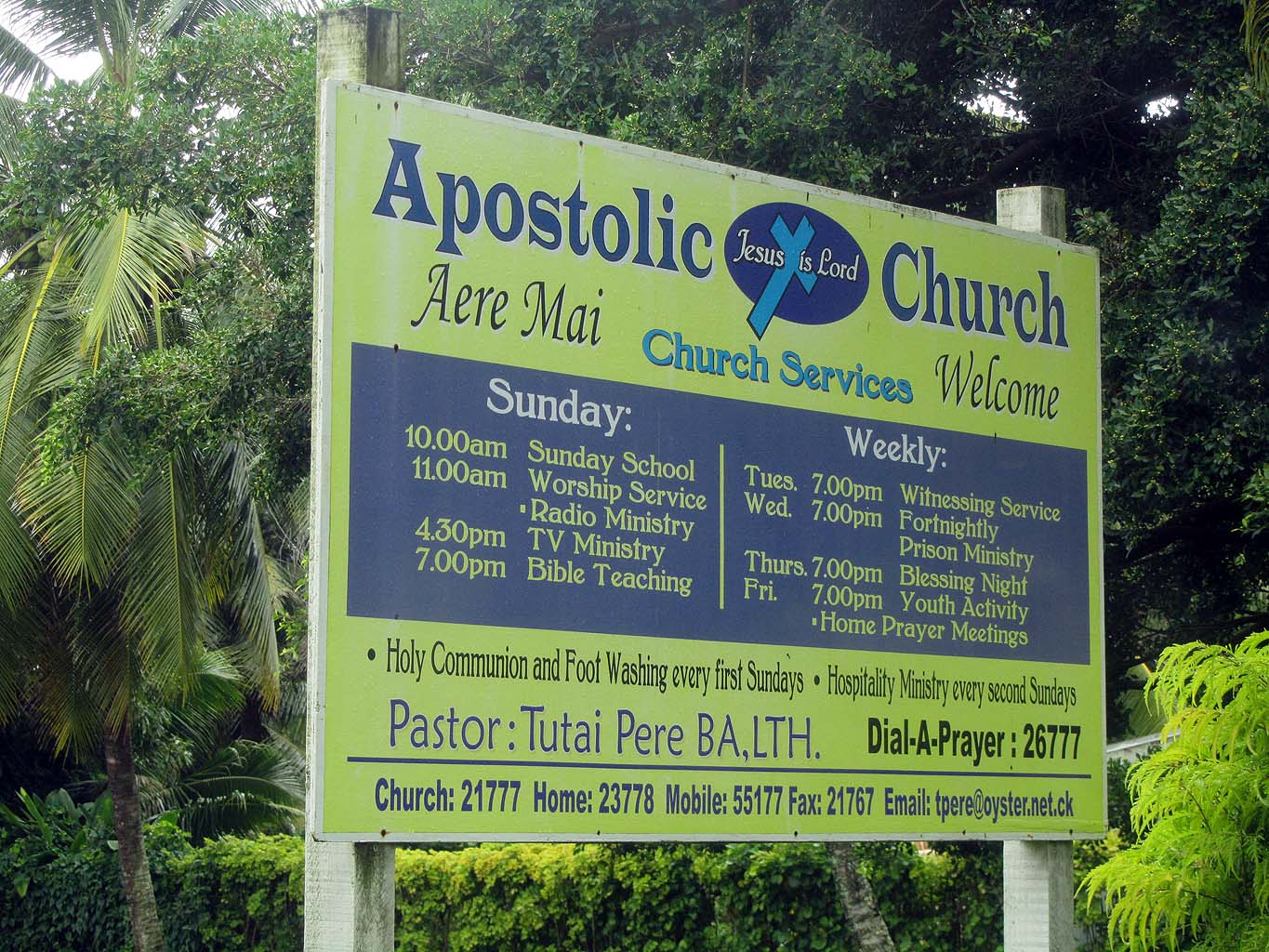
advertizing for one of the many fringe Christian groups on Rarotonga. Here you can have your feet washed, you can, presumably, also get them to come pray at your home. They even have ther own dial-a-prayer service!
Interestingly enough there are many graves in the gardens on Rarotonga. My guess is that this is a continuation of the Polynesian tradition of keeping ancestor bones close to the village, so the mana of the dead can protect the living.
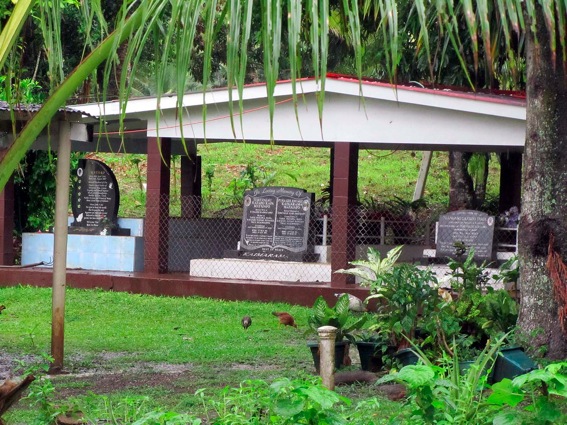
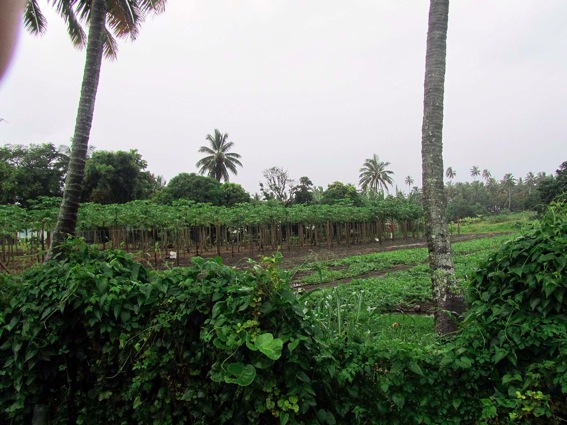
The island is lush and wild as soon as you get a few hundred meters from the oceanfront
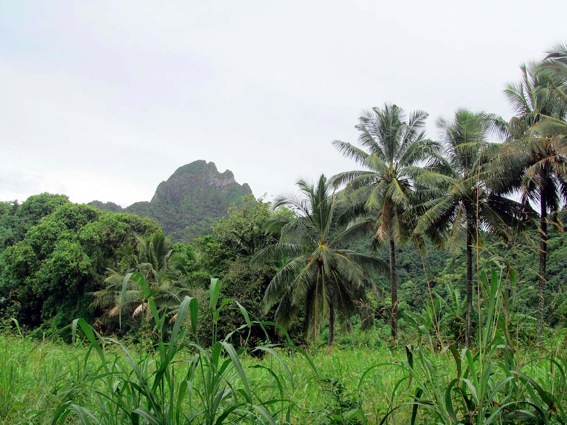
There are fruit trees everywhere. Especially abundant is the papaya, which you can see rows of in the background here:
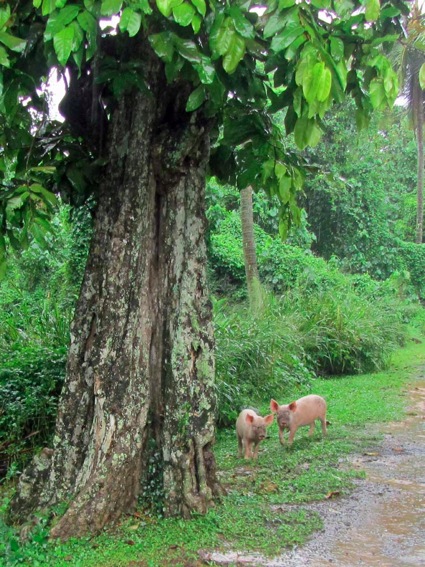
There are lots of pigs and chickens on the island. These guys were strolling along the road and didn’t seem to care much that we were around:
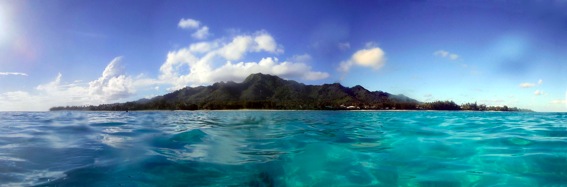
Finally, here is a photo of Rarotonga stitched together from photos we took when we were out snorkeling close to the edge of the reef:
Eirik
—–
