




NZ North Island – Day 12 – Te Papa National Museum
February 20, 2011
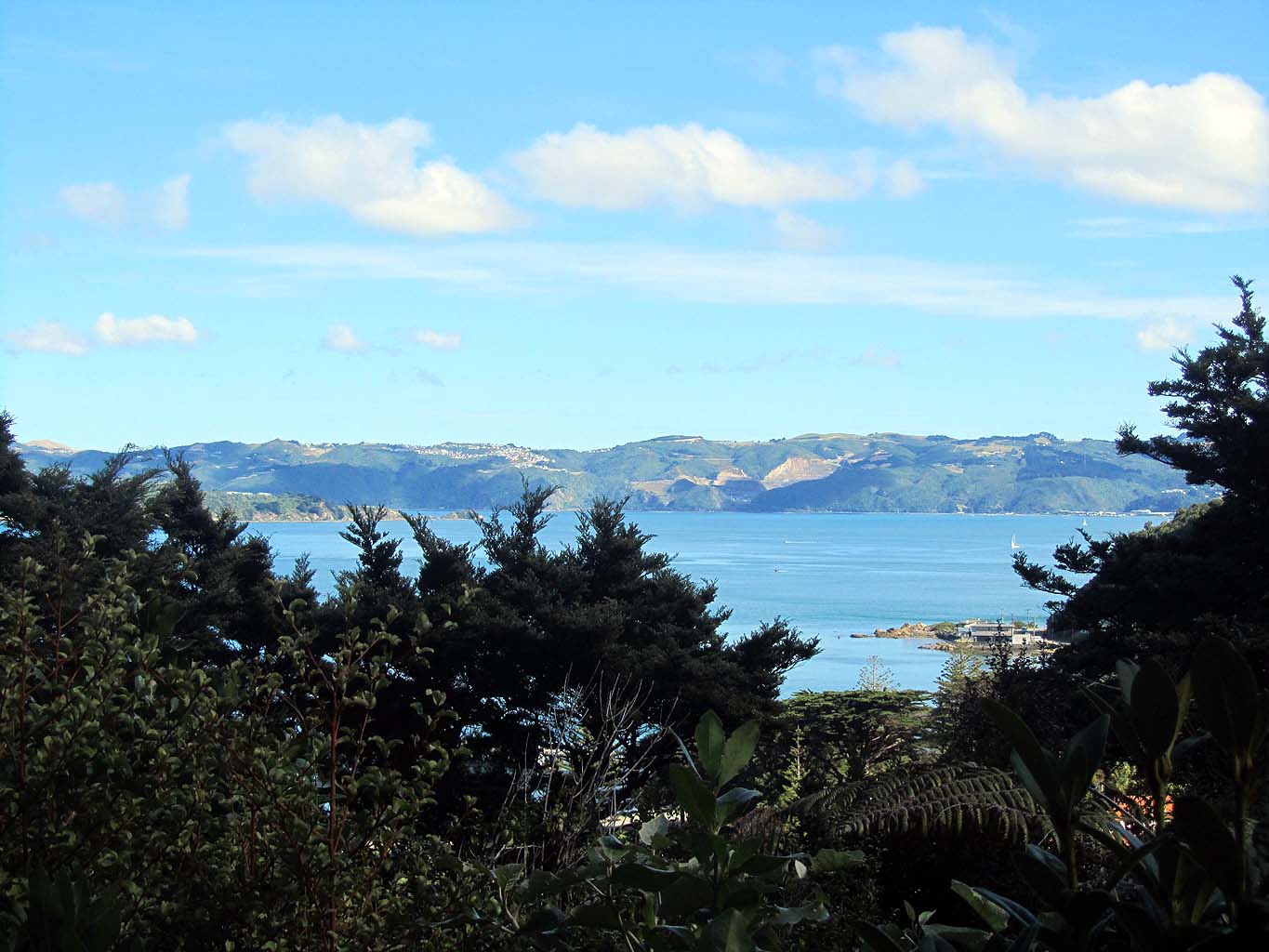
We woke up to a beautiful day and our great view of Wellington Harbour (the bay here is called Wellington Harbour):
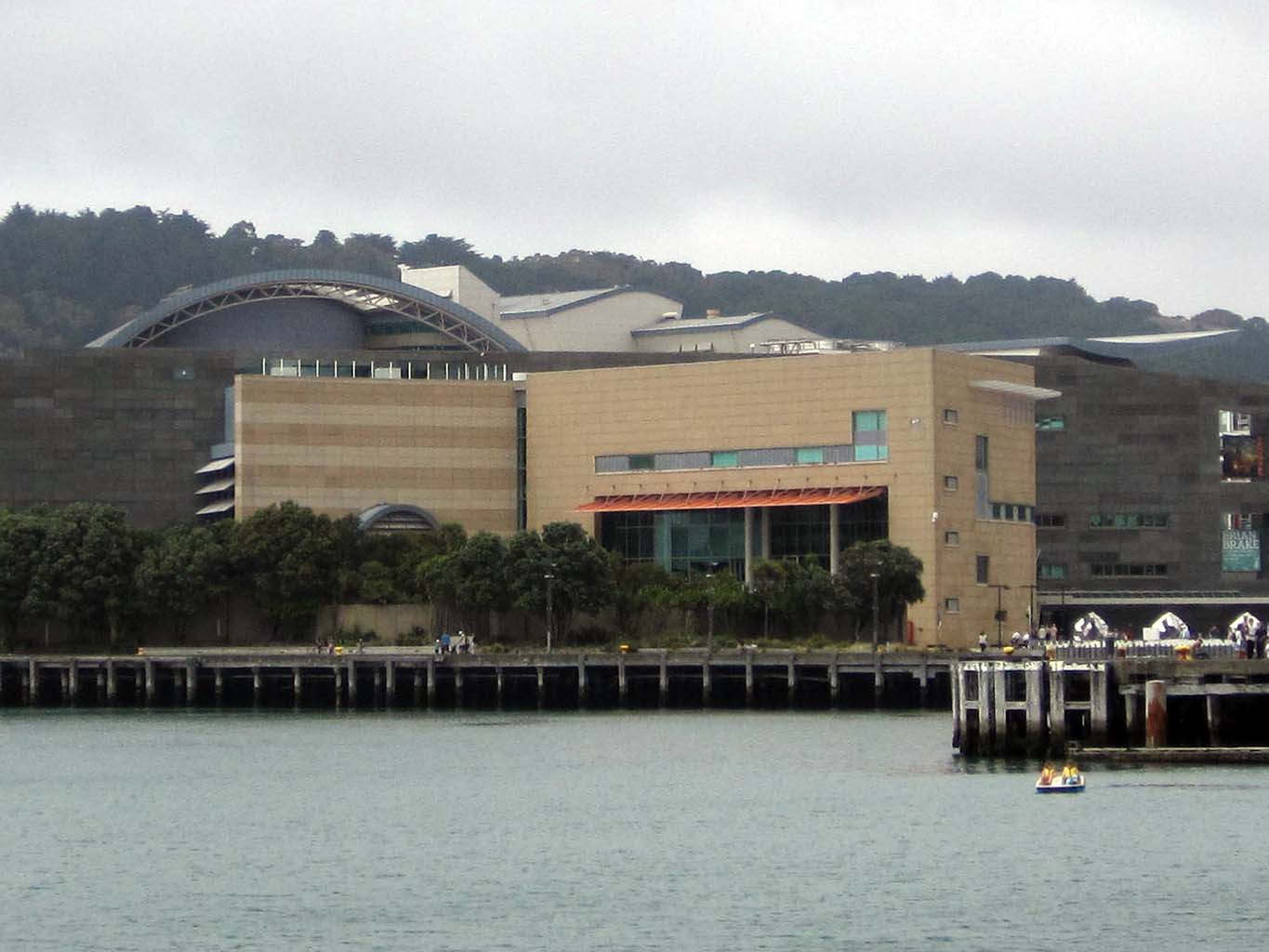
Today´s goal was Te Papa, the national museum. Inside this building lies an extraordinarily cool museum:
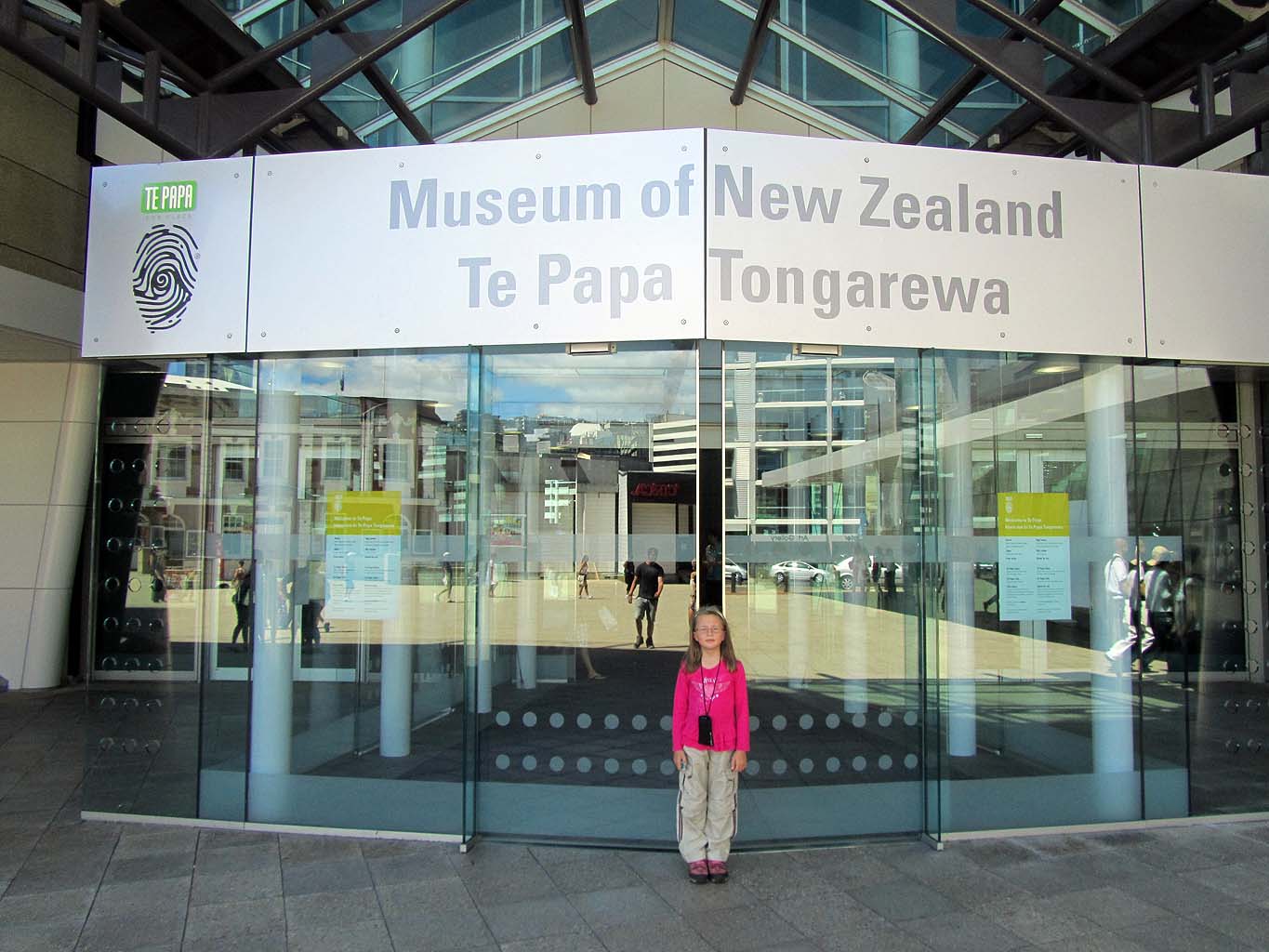
I was well prepared with an empty memory card and two extra fully charged batteries for the camera. Unfortunately we were met by large signs telling us that it was absolutely totally very illegal to even think about taking any photographs in the museum. Awhhhh…
The museum was impressive and we learned a lot more about New Zealand and its history. There was a huge Polynesian section on the first floor.
We learned where the Maroi name for New Zealand, “Aotearoa,” comes from. Originally “Aotearoa” was the Maori name for the north island, but it is today used as the name of all of New Zealand.
According to legend, when the famous sea discoverer Kupe discovered New Zealand, it was his wife who saw the first sign that they were approaching land. When she spotted a long white cloud in the horizon she exclaimed “He ao. He ao. He ao tea. He ao tea roa,” which means “A cloud. A cloud. A white cloud. A long white cloud”
As I have mentioned previously New Zealand was settled by humans in the 13th century as the last significant landmass on earth. One of the reasons why the Polynesians hadn´t discovered it before was that it did not lie in the direction of favorable winds for voyaging. The great Polynesian expansion had been done in an east, south-easterly direction until then. Legend has it, and this sounds probable, that the Polynesians in the Society Islands observed migrating birds leaving them every year in a south-westerly direction. They then concluded that there had to be land in that direction and went looking for it, despite the unfavorable winds.
The islands of New Zealand are also called “Te ika a maui” (fish of Maui) and “Te waka a maui” (canoe of Maui) in Maori.
The legend says that the demi-god Maui used the south island as his canoe when he caught and pulled up a very large fish. This fish then became the north island.
The fish had a nice and flat surface for people to live on and farm, but Maui’s brothers started quarreling over the fish and cut parts of it for their own comnsumption. The fish then wriggled in pain and this created the mountainous landscape.
What I find interesting about this old legend is that the south island does look like a canoe and one can easily imagine the north island as a fish (especially a ray). This then means that the Maori early on must have been able to map New Zealand since they obviously knew what its shape looked like, and they knew this without a writing system and without any known medium they could use to draw maps.
As with many other peoples the common heritage and knowledge was passed from generation to generation in oral legends and stories. They were using the capacity of the human brain for remebering stories, a capacity which is much better than remembering dry facts. Modern day memory tricks use the same phenomenon to make it possible to remember numbers and facts. As a teenager I learned a system for translating all 10 digits into letters. To remember two digits I put their letters together and find a word which starts with these two letters (wovels do not count, making it easy to always find a word). I can then make up a story where the words appear in succession representing sequences of digits. There is much more information in the story then in the digits, but for some reason the human brain is much better at remembering the story. I can still remember phone numbers of friends in high school because I remember the stories connected with them.
This incidently was also how all the information necessary for becoming an expert Polynesian navigator was stored. A navigator had to be able to recite many stories contining information about the position of stars, the occurrence of ocean currents, wind and cloud paterns etc, etc.
The Polynesians arriving in New Zealand also had to adopt to a very different and much colder climate than they were used to from the Pacific islands. They needed to get used to a different flora. Coconuts were no longer available, nor were the bark used to make fibers for clothing. The flax plant became very important. This very common plant here, with very long flat leaves has very strong fibers and was used for clothing and for weaving of many useful objects.
In my infinite naivety I have always thought that fishing lures were a modern invention, I mean the kind that imitates a fish or an insect in the water. Not so, they had 2000 year old Polynesian lures made from sea shell on display!
There was a huge impressive section on tectonic plates, covering volcanos and earthquakes.
We also learned a lot about the flora and fauna of NZ and the reason there are so many endemic (only found here) species.
New Zealand was once part of a very large continent which has been named Gondwana. It consisted of what is today South America, Africa, India, Antartica, Australia and New Zealand. About 150 million years ago this continent started to split up. When it split up each piece carried on the flora and fauna of Gondwana and evolution brought new variations of them and new species as time passed.
When New Zealand was separated, about 80 million years ago, it happened to be very close to the South Pole and had a very harsh climate. Thus very few species existed there when it got isolated. Crucially, not a single mammal lived there. When humans (the Polynesians) arrived in New Zealand the only mammals here were bats, which presumably had flown over from Australia.
In this mammal-free environment there were few predators and a very different genetic pressure than in the other parts of Gondwana. Many flightless birds evolved. Why spend energy on flying when you don´t need to get away quickly? Insects also became abnormally large (what a shame I cannot show pictures here, Gwen), New Zealand´s giant weta is the world´s largest insect and weighs more than most mice. In fact, the weta occupied the same ecological niche as mice on New Zealand.
Some birds, like the now extinct moa, became very large.
Very large animals are also referred to as “the megafauna.” About 100 000 years ago there were many very large species of animals that are now extinct. Their history is the history of mankind´s proliferation across the earth. Archelogical records show clearly that as soon as humans conquered a new piece of land the megafauna quickly died out as it was hunted for food by humans.
The museum was the most child-friendly museum we have ever been to, hands down. There were many separate kid sections and playgrounds and activity centers all over. One part was so cool we risked our freedom and took some pictures. Here they are. So sue us!
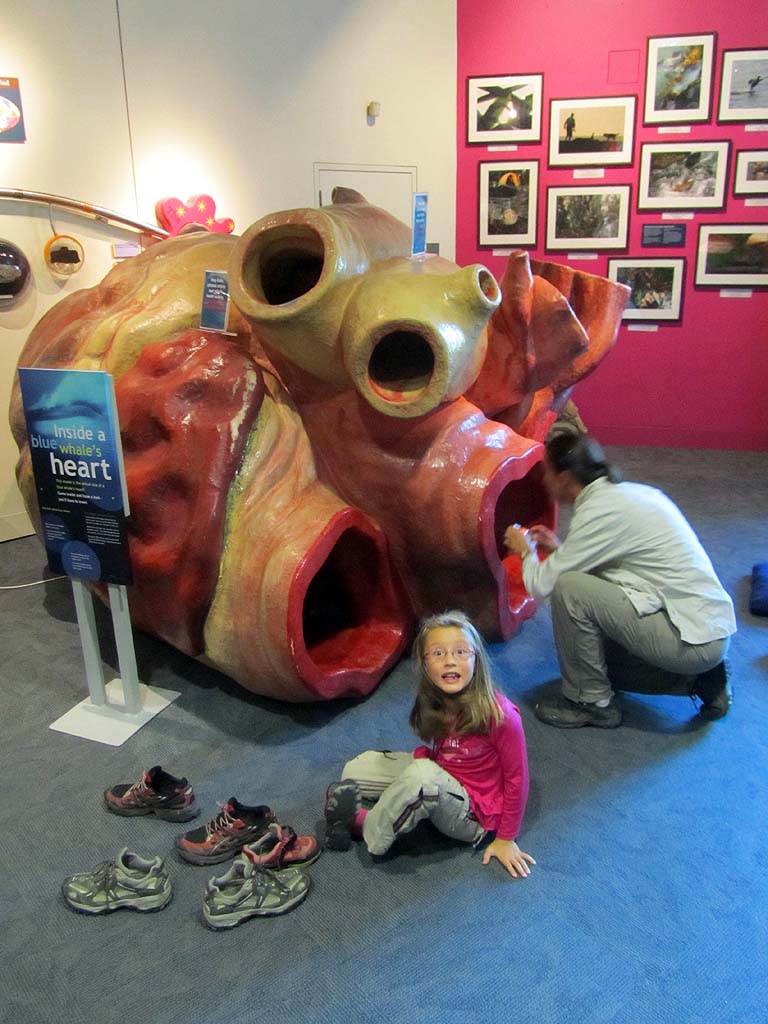
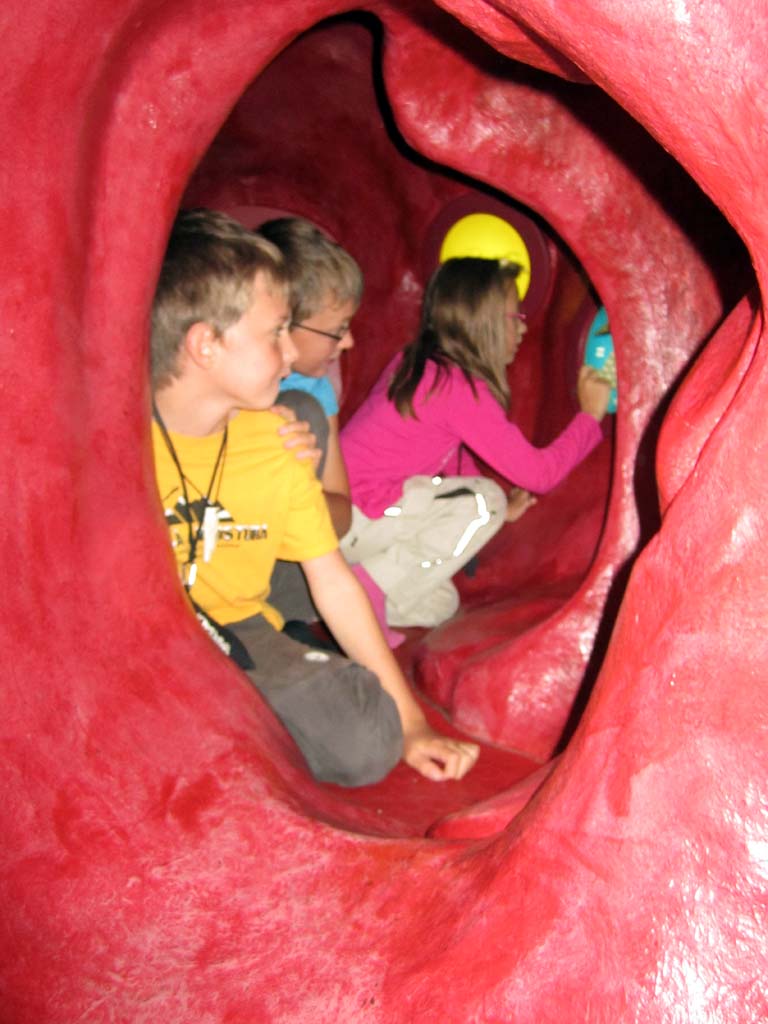
That is a 1:1 model of the heart of a blue whale, and you can crawl though it. Isn´t that ultracool?
They were preparing an exhibit of a giant squid. A 4.2 meter monster which had been caught close to Antarctica in 2007 and frozen. We saw a movie about it and could also barely see its contour in a partly covered tank. It will be the only complete specimen on display anywhere. In fact it is the only complete specimen ever found.
We spent our whole day at the museum and could easily have spent one more. What a fantastic institution they have made here. And entrance was free!
There was even free wifi:
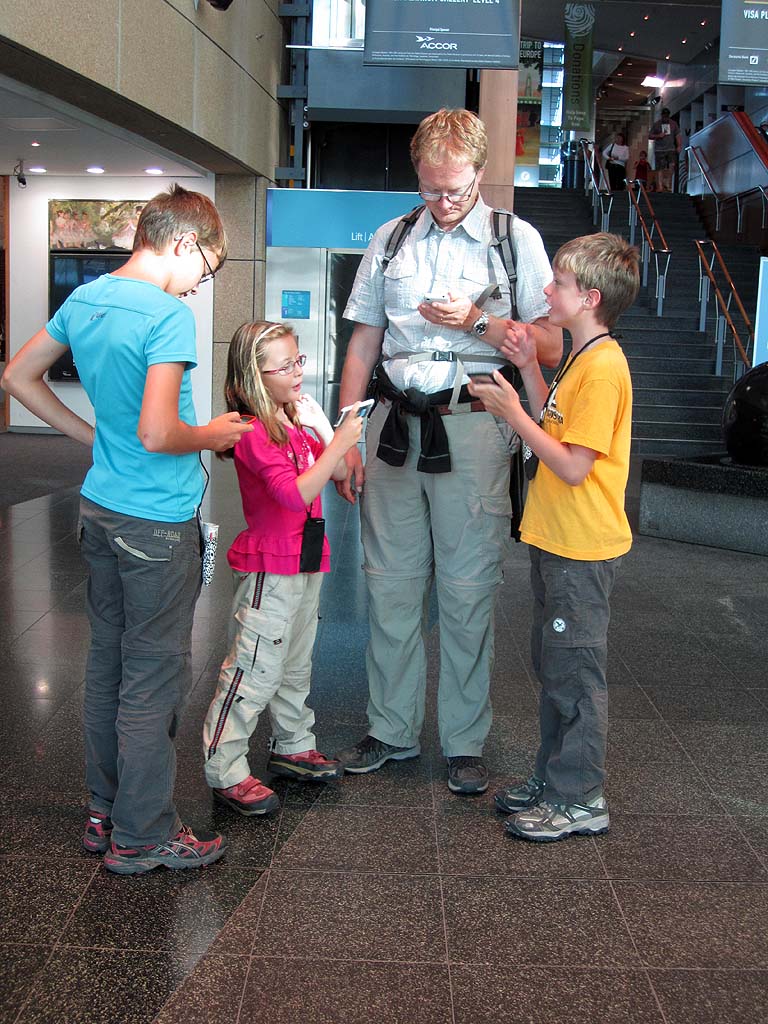
Our last full day on the north island was over. Tomorrow new adventures avait us in the south.
Eirik
—–
